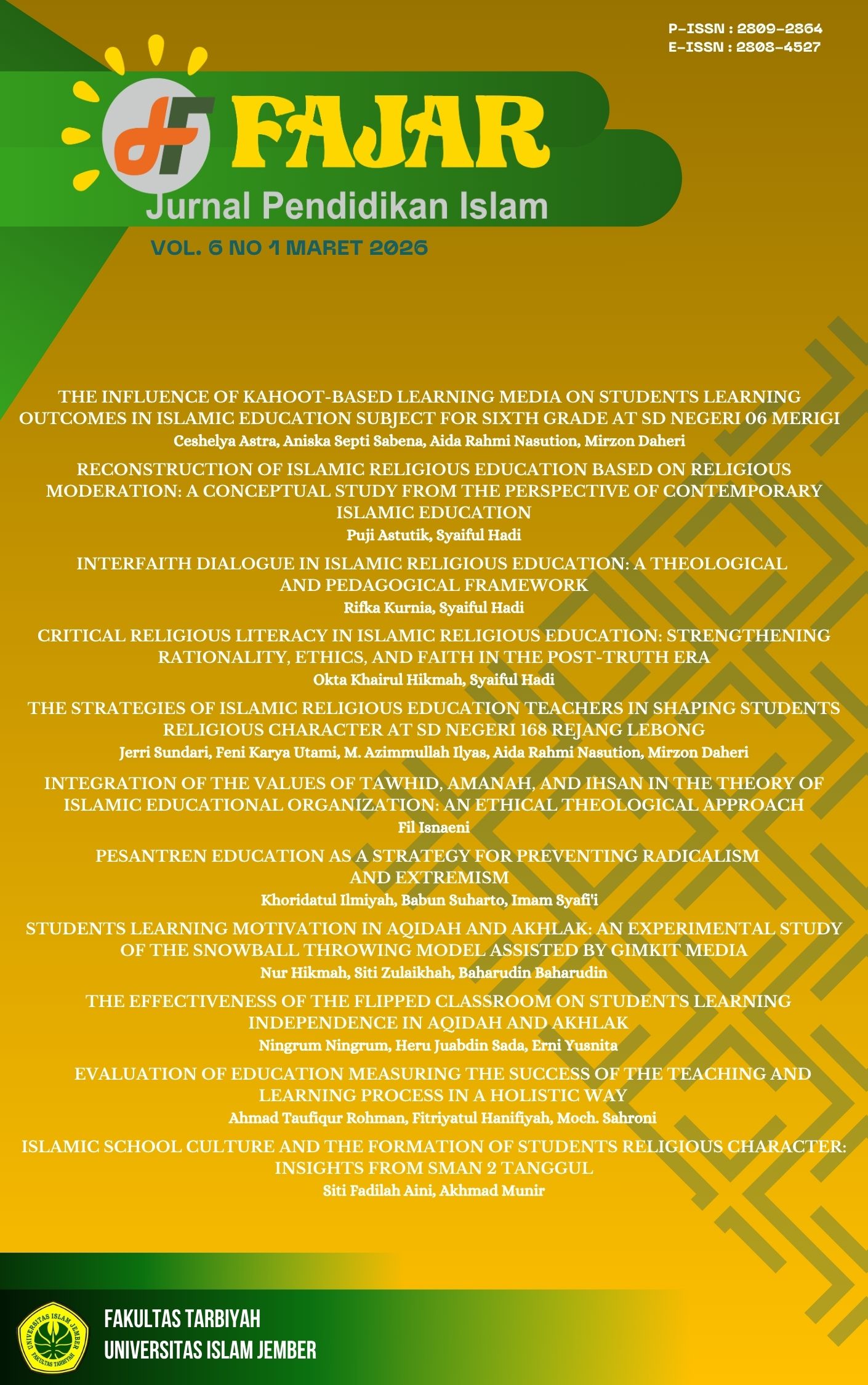
INTEGRATION OF THE VALUES OF TAWHID, AMANAH, AND IHSAN IN THE THEORY OF ISLAMIC EDUCATIONAL ORGANIZATION: AN ETHICAL THEOLOGICAL APPROACH
DOI:
https://doi.org/10.56013/fj.v6i1.5184Keywords:
Pendidikan Islam, Etis-Teologis, TauhidAbstract
This article aims to conceptually analyze organizational theory from the perspective of Islamic values and ethics through the integration of three main principles, namely monotheism, amanah, and ihsan. This study uses a qualitative approach with the library research method. The results of the study show that monotheism functions as an ontological foundation that affirms that the existence of the organization is rooted in divine consciousness and oriented towards falah (success in the world-hereafter). Amanah plays a role as an epistemological principle that guides organizational governance based on justice, honesty, and moral responsibility. Meanwhile, ihsan is an axiological dimension that shapes the performance ethics and culture of professional organizations based on sincerity and spiritual awareness. The integration of these three values resulted in a holistic and equitable model of Islamic organizational theory, combining the rationality of modern management with Islamic spirituality. Implicitly, this theory not only enriches the academic discourse of Islamic management, but also offers a practical paradigm in building an organization that is efficient, moral, and oriented towards the benefit of the ummah (rahmatan lil 'alamin).
References
Ahmad M. Latief, Achmad Abubakar, dan Mardan. “QUR’ANIC VALUES AS THE FOUNDATION OF ISLAMIC WORK ETHIC: A THEMATIC STUDY ON THE CONCEPTS OF ‘AMAL, AMANAH, AND ISTIQĀMAH.” Tadbir: Jurnal Manajemen Pendidikan Islam 13, no. 3 (November 2025): 713–25. https://doi.org/10.30603/tjmpi.v13i3.7033.
Aisyah, Siti, dan Badrudin Badrudin. “MANAJEMEN KEPEMIMPINAN KEPALA SEKOLAH EFEKTIF PADA SEKOLAH INKLUSIF.” Jurnal Isema : Islamic Educational Management 1, no. 1 (Juni 2019). https://doi.org/10.15575/isema.v1i1.4986.
Bassar, Agus Samsul, Uus Ruswandi, dan Mohamad Erihadiana. “Pendidikan Islam: Peluang dan Tantangan di Era Global dan Multikultural.” J-PAI: Jurnal Pendidikan Agama Islam 8, no. 1 (Desember 2021). https://doi.org/10.18860/jpai.v8i1.9577.
Budiman, Septian Arief, Zohaib Hasan Sain, dan Wiwit Kurniawan. “The Role of Religious Extracurricular Program Activities in Fostering Religious Moderation among Students of Public Universities.” Tarbawi: Jurnal Keilmuan Manajemen Pendidikan 10, no. 02 (2024): 231–42.
Hameed, Imran, Zeeshan Ahmed Bhatti, Muhammad Asif Khan, dan Sumaiya Syed. “How and When Islamic Work Ethic (IWE) Leads to Employee Promotive and Prohibitive Voice? The Interplay of Employee Moral Identity and Perceived Voice Opportunity.” International Journal of Islamic and Middle Eastern Finance and Management 13, no. 4 (Juli 2020): 593–612. https://doi.org/10.1108/IMEFM-09-2019-0382.
Harahap, Muhammad Said Zulkarni. “MANAJEMEN PENGEMBANGAN BUDAYA ORGANISASI BERBASIS IHSAN DI MAS AL-HIKMAH TEBING TINGGI.” PIONIR: JURNAL PENDIDIKAN 11, no. 1 (April 2022). https://doi.org/10.22373/pjp.v11i1.13090.
Hasanah, Riskiyah, Khoirun Nisa’, Akmal Mundiri, Umar Manshur, dan Zainal Munir. “Integrating Situational Leadership and Traditional Values: Enhancing Student Discipline in Islamic Boarding Schools Through Holistic Training Programs.” Communautaire: Journal of Community Service 3, no. 2 (Agustus 2024): 138–51. https://doi.org/10.61987/communautaire.v3i2.463.
Humaisi, M. Syafiq, dan Muhammad Thoyib. “Charismatic Leadership in Improving the Quality of Islamic Boarding School Education.” Al-Hayat: Journal of Islamic Education 9, no. 3 (September 2025): 662–77. https://doi.org/10.35723/ajie.v9i3.208.
Ilham, Dodi. “Challenge of Islamic Education and How to Change.” International Journal of Asian Education 1, no. 1 (Juni 2020): 09–20. https://doi.org/10.46966/ijae.v1i1.16.
Ismail, Ismail, Hapzi Ali, dan Kasful Anwar Us. “FACTORS AFFECTING CRITICAL AND HOLISTIC THINKING IN ISLAMIC EDUCATION IN INDONESIA: SELF-CONCEPT, SYSTEM, TRADITION, CULTURE. (LITERATURE REVIEW OF ISLAMIC EDUCATION MANAGEMENT).” Dinasti International Journal of Management Science 3, no. 3 (Januari 2022): 407–37. https://doi.org/10.31933/dijms.v3i3.1088.
Karagianni, Despoina, dan Anthony Jude Montgomery. “Developing Leadership Skills among Adolescents and Young Adults: A Review of Leadership Programmes.” International Journal of Adolescence and Youth 23, no. 1 (Januari 2018): 86–98. https://doi.org/10.1080/02673843.2017.1292928.
Mahmoud, Mahmoud Ahmad, Umar Habibu Umar, Muhammad Bilyaminu Ado, dan Tasiu Tijjani Kademi. “Factors Influencing the Financial Satisfaction of MSME Owners: The Mediating Role of Access to Islamic Financing.” Management Research Review 47, no. 3 (Januari 2024): 422–40. https://doi.org/10.1108/MRR-01-2022-0047.
Mahmudi, Aries, Abdul Hamid, dan Apri Wahyudi. Kepemimpinan Dalam Pendidikan Islam. Purbalingga: Eureka Media Aksara, 2024.
Mubarok, Muhammad Khusni, Abd. Syakur, Moh. Farih Fahmi, dan Rizki Prasetya. “A Character Education Framework Grounded in Exemplary Leadership: Insights and Applications.” Tadris: Jurnal Keguruan Dan Ilmu Tarbiyah 9, no. 2 (Desember 2024): 659–73. https://doi.org/10.24042/tadris.v9i2.25086.
Mucharomah, Miftah, Corresponding author, IAIN Pekalongan, Indonesia, m.sugeng.s@iainpekalongan.ac.id, MSI 17 Pabean, Pekalongan, Indonesia, miftahmucharomah@gmail.com, Wirani Atqia, IAIN Pekalongan, Indonesia, wirani.atqia@iainpekalongan.ac.id, Rofiqotul Aini, dan IAIN Pekalongan, Indonesia, rofiqotul.aini@iainpekalongan.ac.id. “Developing Children’s Islamic Spiritual Intelligence in the Digital Age: Indonesian Family Education Methods.” International Journal of Instruction 16, no. 1 (Januari 2023): 357–76. https://doi.org/10.29333/iji.2023.16120a.
Muhammad Mamduh Nuruddin, Riyan Hidayatulloh, dan Septian Arief Budiman. “PENGEMBANGAN KEPEMIMPINAN INKLUSIF DALAM PENDIDIKAN ISLAM DI ERA 5.0: MENINGKATKAN KOLABORASI DIGITAL ANTARA SEKOLAH, PESANTREN, DAN MASYARAKAT.” JURNAL KEPEMIMPINAN & PENGURUSAN SEKOLAH 10, no. 2 (Juni): 327–36. https://doi.org/10.34125/jkps.v10i2.478.
Ningsih, Rindia, Muhammad Ricky Hardiyansyah, Muhammad Adika Nugraha, Nurasiah Nurasiah, dan Abdul Azis. “Analisis Pelaksanaan Pendidikan Karakter Untuk Mengatasi Krisis Moral Mahasiswa Program Studi Pendidikan Sejarah Universitas Islam Sumatera Utara.” Education & Learning 3, no. 2 (Agustus 2023): 20–25. https://doi.org/10.57251/el.v3i2.1033.
Nurhuda, Abid. “Islamic Education in the Family: Concept, Role, Relationship, and Parenting Style.” Journal Corner of Education, Linguistics, and Literature 2, no. 4 (Maret 2023): 359–68. https://doi.org/10.54012/jcell.v2i4.153.
Rosyid, M. “Peran Kepemimpinan Digital dalam Manajemen Lembaga Pendidikan Islam.” Jurnal Kepemimpinan dan Pendidikan Islam 3, no. 1 (2021): 10–25.
Udin, Udin, Radyan Dananjoyo, Mohsin Shaikh, dan Densy Vio Linarta. “Islamic Work Ethics, Affective Commitment, and Employee’s Performance in Family Business: Testing Their Relationships.” Sage Open 12, no. 1 (Januari 2022): 21582440221085263. https://doi.org/10.1177/21582440221085263.
Yousaf, Ummara, Muhammad Faizan Khan, Ismail Khan, Muhammad Zubair Khan, dan Muhammad Nadeem Dogar. “Spiritually Empowered Leadership and Workplace Spirituality at Akhuwat Foundation: A Qualitative Case Study.” Qualitative Research in Financial Markets 17, no. 5 (Desember 2025): 952–74. https://doi.org/10.1108/QRFM-04-2024-0103.
Zahraini, Zahraini, Akib Akib, Rosidin Rosidin, dan Otong Sulaeman. “Islamic Education Reform in the Digital Age: Challenges and Opportunities for a Modern Curriculum.” Journal of Noesantara Islamic Studies 2, no. 1 (Februari 2025): 1–11. https://doi.org/10.70177/jnis.v2i1.1841.
Downloads
Published
How to Cite
Issue
Section
License
Copyright (c) 2026 Fil Isnaeni

This work is licensed under a Creative Commons Attribution-ShareAlike 4.0 International License.