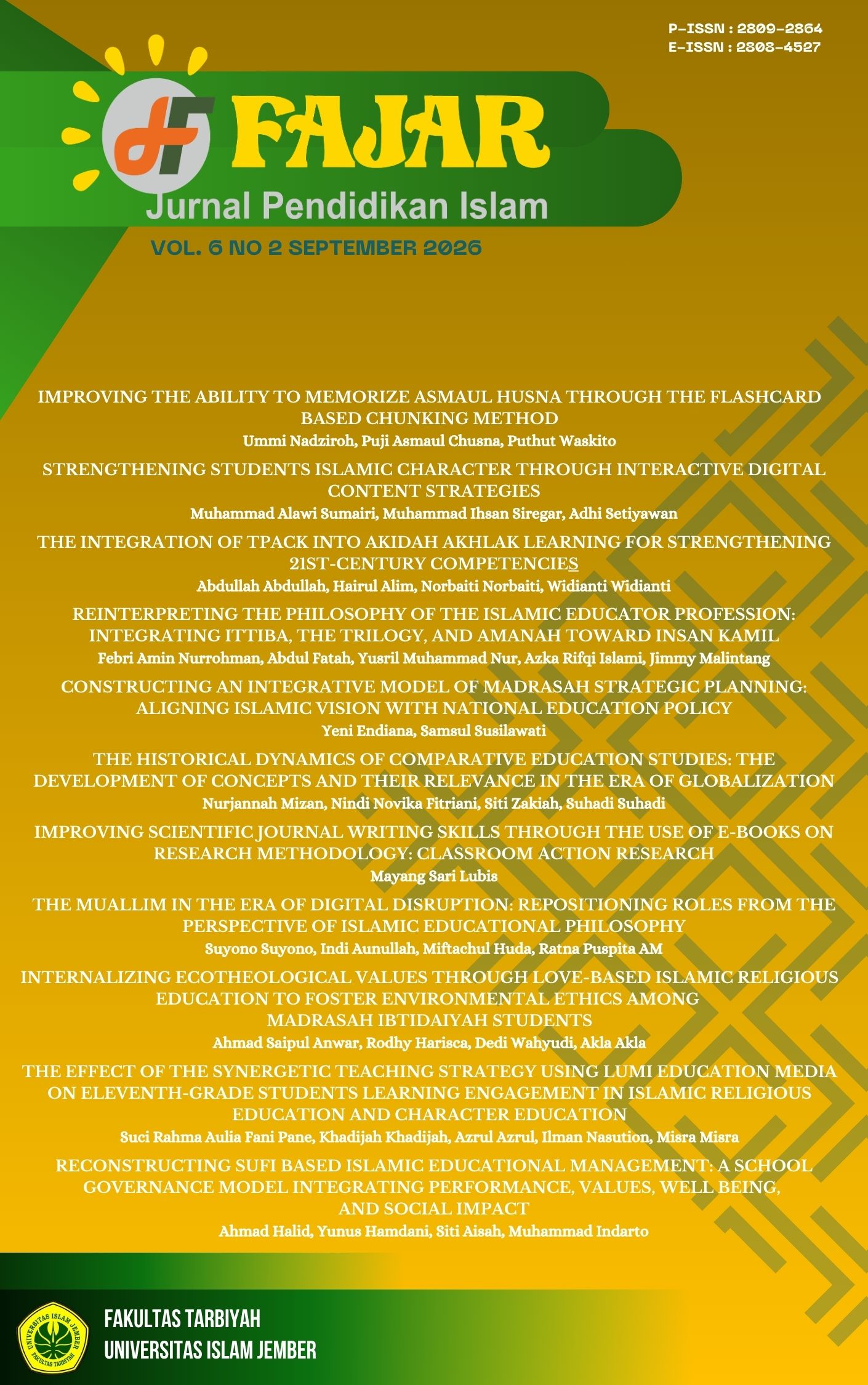
IMPROVING SCIENTIFIC JOURNAL WRITING SKILLS THROUGH THE USE OF E-BOOKS ON RESEARCH METHODOLOGY: CLASSROOM ACTION RESEARCH
DOI:
https://doi.org/10.56013/fj.v6i2.6514Keywords:
Scientific Writing Skills, E-book, Research Methodology, Classroom Action ResearchAbstract
Before the classroom action research (PTK) was conducted, some students still struggled to develop ideas, organize the structure of an article, cite references, and edit manuscripts according to academic standards. This study aims to improve students’ ability to write scientific journal articles through the use of an e-book on research methodology. This study employed the Classroom Action Research (CAR) method based on the Kemmis and McTaggart model, conducted in two cycles consisting of the planning, action, observation, and reflection stages. The assessment instruments in this study were a rubric for evaluating students’ scientific journal article writing skills and an observation sheet to monitor the learning process. The research subjects consisted of 18 fifth-semester students in the Islamic Religious Education Program at STAI Al-Hikmah Medan during the 2025/2026 academic year, who were enrolled in the Research Methodology course. The writing skill indicators measured included the ability to develop ideas, organize the structure of an article, construct arguments, use references, employ scientific language, and revise and edit the text. Research data were obtained through the assessment of journal article writing skills and observations, and were subsequently analyzed using descriptive quantitative methods. The research results show a gradual improvement in scientific journal writing skills. In the pre-cycle, the students’ average score was 67.6, with a mastery rate of 38.9% (7 students). In Cycle I, the average score increased to 74.6, with a mastery rate of 66.7% (12 students). In Cycle II, the average score increased again to 81.05, with a mastery rate of 83.3% (15 students). In addition to improved learning outcomes, this study also resulted in two published scientific journal articles. Thus, the use of the e-book “Research Methodology,” combined with writing exercises, guidance, feedback, and revisions, can serve as a learning strategy to improve PAI students’ ability to write scientific journal articles and create a learning process that is more active, collaborative, and focused on academic output.
References
Amir, Amril, Farel Olva Zuve, Adhara Jasid, and Dinda Annisa, ‘Digital Book as Alternative Solution in Learning During the Pandemic in Indonesia’, in 4th International Conference on Language, Literature, and Education (ICLLE-4 2021) (Atlantis Press, 2021), pp. 7–10, doi:https://doi.org/102991/assehr.k.211201.002
Amna, Zaujatul, Achmad Syaukani, Faizal Adriansyah, and Sarah Hafiza, ‘Pengaruh Metode Deep Dialogue Critical Thinking (DDCT) Terhadap Peningkatan Kemampuan Menulis Karya Ilmiah Pada Mahasiswa.’, Gadjah Mada Journal of Professional Psychology, 8.1 (2022), pp. 1–12, doi:https://doi.org/10.22146/gamajpp.72753
Ariyanto, Sudirman, Wahyu Cahyadi, and Ata Nugraha, ‘Strategi Penulisan Artikel Ilmiah Untuk Lolos Publikasi Jurnal Terakreditasi Sinta Bagi Mahasiswa Bidang Teknik’, Madiun Spoor: Jurnal Pengabdian Masyarakat, 3.2 (2023), pp. 47–51, doi:https://doi.org/10.37367/jpm.v3i2.319
Batubara, Hamdan Husein, ‘Developing a Digital Book of Proficiency in Writing Scientific Articles with Artificial Intelligence to Improve Elementary Education Students’ Scientific Writing Skills’, At-Thullab: Jurnal Pendidikan Guru Madrasah Ibtidaiyah, 9.1 (2025), pp. 13–31, doi:https://doi.org/10.30736/atl.v9i1.2405
Lubis, Mayang Sari, Metodologi Penelitian (Deepublish, 2018) <https://books.google.co.id/books?hl=id&lr=&id=x_NlEQAAQBAJ&oi=fn>
Lubis, Mayang Sari, Muhammad Hasan, Uci Putri Ayu, and Feby Permatasari, ‘Implementasi Metode Storytelling Dalam Pembelajaran PAI Siswa Kelas V SD Swasta Melyaz Percut Sei Tuan’, Jurnal Pendidikan Tambusai, 9.3 (2025), pp. 34485–91, doi:https://doi.org/10.31004/jptam.v9i3.33329
Lubis, Mayang Sari, Marwiyah Tanjung, Fazira Hapsari, Siti Aisyah, and Tiya Indah, ‘Konsep Pendidikan Islam Humanis Dan Moderat Dalam Pandangan Yusuf Al-Qardhawi’, Jurnal Pendidikan Tambusai, 10.1 (2026), pp. 131–39, doi:https://doi.org/10.31004/jptam.v10i1.35752
Novi, Widya, Angga Dewi, Qurnia Fitriyaninur, and M Hafidz Ahdiansyah, ‘Penguatan Kompetensi Penulisan Artikel Berstandar Sinta Dari Riset Gap Hingga Limitasi’, TEMATIK: Jurnal Pengabdian Kepada Masyarakat, 6.2 (2026), pp. 116–25, doi:https://doi.org/10.26623/tematik.v6i2.15731
Rahman Renaldi, Agung Nugroho, Dian Ramadan Lazuardi, ‘Penerapan Model Pembelajaran Kooperatif Tipe Group Investigation Terhadap Kemampuan Menulis Karya Ilmiah Siswa Kelas XI SMA Negeri 4 Lubuklinggau’, Lembaga Publikasi Penelitian Pengabdian Masyarakat Dan Karya Ilmiah Linggau (LP3MKIL), 5.1 (2025), pp. 29–36, doi:https://doi.org/10.55526/ljlel.v5i1
Rizki Fadila Nasution, Penda Sudarto Hasugian, Mara Untung Ritonga, ‘Perancangan Sistem Penilaian Digital Terintegrasi Akreditasi Jurnal Nasional Untuk Meningkatkan Akurasi Dan Efektivitas Pembelajaran Menulis Ilmiah Mahasiswa STMIK Pelita Nusantara’, Jurnal Teknologi Informasi Dan Komunikasi Dalam Pendidikan, 12.1 (2025), pp. 45–53, doi:https://doi.org/10.24114/jtikp.v12i1.67299
Santoso, Erik, Nia Kania, Iik Nurhikmayati, M Gilar Jatisunda, and Vici Suciawati, ‘Pelatihan Penelitian Tindakan Kelas Sebagai Bentuk Pengembangan Profesionalisme Guru’, BERNAS: Jurnal Pengabdian Kepada Masyarakat, 2.2 (2021), pp. 504–9, doi:https://doi.org/10.31949/jb.v2i2.832
Syaifudin, ‘Penelitian Tindakan Kelas ( Teori Dan Aplikasinya Pada Pembelajaran Bahasa Arab )’, Borneo: Journal of Islamic Studies, 1.2 (2021), pp. 1–17, doi:https://doi.org/10.37567/borneo.v1i2.440
Ulfah, Anisa, ‘Problematika Penulisan Karya Ilmiah Mahasiswa’, Media Didaktika, 10.2 (2024), pp. 1–9, doi:https://doi.org/10.52166/didaktika.v10i2.8045
Utomo, Prio, Nova Asvio, and Fiki Prayogi, ‘Metode Penelitian Tindakan Kelas ( PTK ): Panduan Praktis Untuk Guru Dan Mahasiswa Di Institusi Pendidikan’, Pubmedia Jurnal Penelitian Tindakan Kelas Indonesia, 1.4 (2024), pp. 1–19, doi:https://doi.org/10.47134/ptk.v1i4.821
Downloads
Published
How to Cite
Issue
Section
License
Copyright (c) 2026 Mayang Lubis

This work is licensed under a Creative Commons Attribution-ShareAlike 4.0 International License.