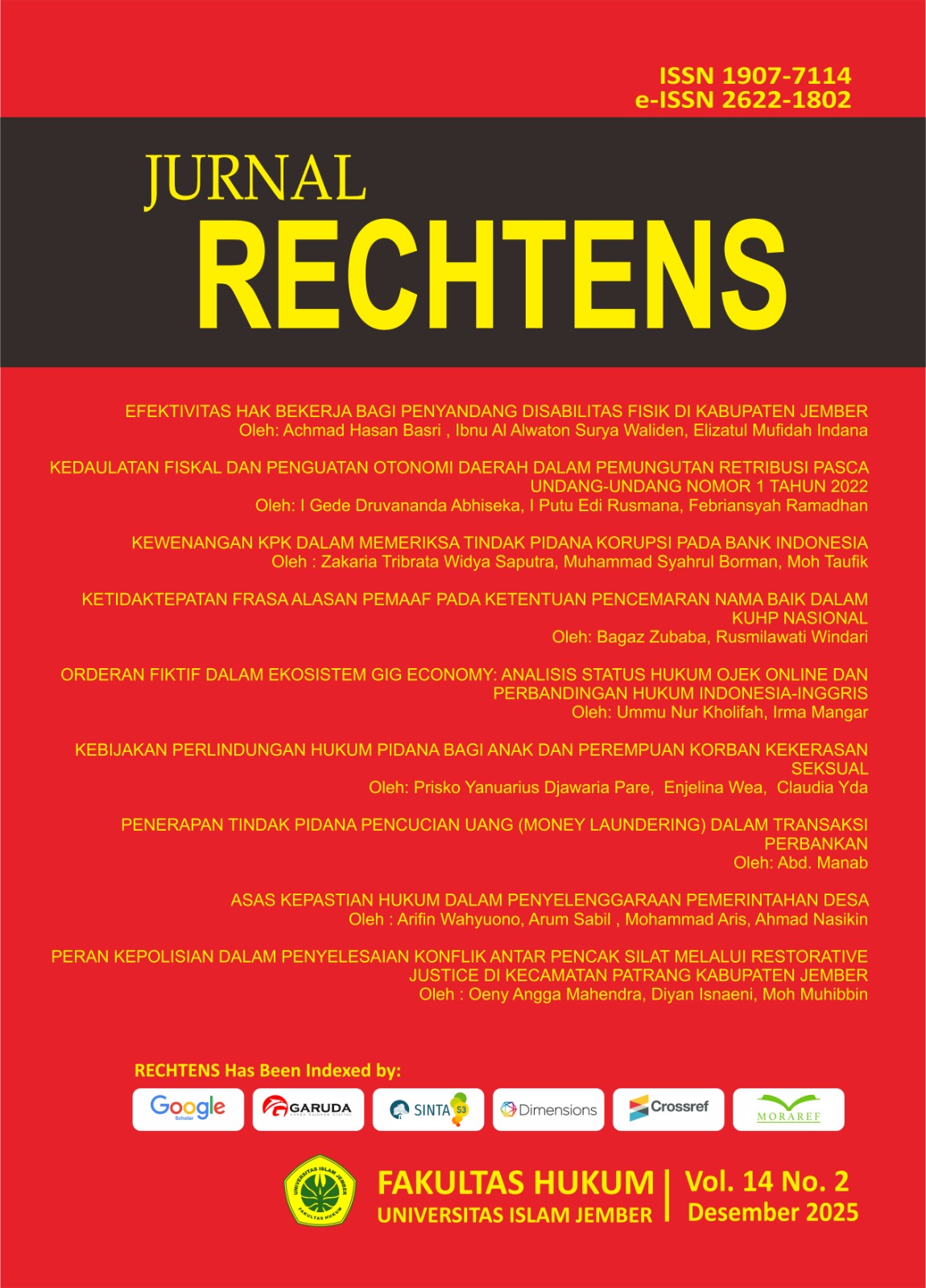
Orderan Fiktif Dalam Ekosistem Gig Economy: Analisis Status Hukum Ojek Online dan Perbandingan Hukum Indonesia-Inggris
DOI:
https://doi.org/10.56013/rechtens.v14i2.4919Keywords:
Legal Status, Online Motorcycle Taxis, Fictitious Orders, Legal ComparisonsAbstract
The development of digital technology has encouraged the birth of the gig economy that offers work flexibility through digital platforms such as online motorcycle taxis (ojol). However, the legal status of ojol drivers who are classified as partners, not workers, raises significant problems, especially related to the case of fictitious orders. This study aims to analyze the implications of the legal status of gig workers in Indonesia, especially ojol drivers, and to make a comparison with regulations in the UK. The research method used is normative-empirical law with a legislative, comparative law, and case approach. Primary data was obtained through interviews and observations of ojol drivers in Bojonegoro, while secondary data came from laws and regulations and court decisions. The results of the study showed that all respondents had experienced fictitious orders that caused economic and psychological losses, but did not receive legal protection due to their status as partners. The standard clause in the platform agreement shifts all responsibility to drivers, reflecting their weak bargaining position. Meanwhile, a comparison with the UK through the Uber BV v Aslam decision shows that drivers are categorized as workers who are entitled to basic protections such as minimum wage and paid leave
Downloads
References
Jurnal:
Adams-Prassl, Jeremias. “Uber BV v Aslam: ‘[W]Ork Relations ⋯ Cannot Safely Be Left to Contractual Regulation.’” Industrial Law Journal 51, no. 4 (2022): 955–66. https://doi.org/10.1093/indlaw/dwac027.
Aminuddin, Nur Afifah. “Legal Protection of the Digital Platform Workers in Indonesia : Lesson Learned From Germany and the United Kingdom,” no. September (2023): 247–75. https://doi.org/10.19184/ijls.v4i2.41915.
Beda Soedrio, Rudepel Petrus Leo, and Deddy R. Ch. Manafe. “Perlindungan Hukum Terhadap Driver Maxim Akibat Pemesanan Orderan Fiktif/Penipuan Food and Goods and Delivery Dengan Pembayaran COD Pada Minimarket Kepada Costumer Di Wilayah Kota Kupang.” Jurnal Hukum, Politik Dan Ilmu Sosial 3, no. 3 (2024): 216–31. https://doi.org/10.55606/jhpis.v3i3.3910.
Bertolini, Alessio, and Ruth Dukes. “Trade Unions and Platform Workers in the UK: Worker Representation in the Shadow of the Law.” Industrial Law Journal 50, no. 4 (2021): 662–88. https://doi.org/10.1093/indlaw/dwab022.
Bogg, Alan. “The Uber Case: The Legal Construction of Platform Work.” Modern Law Review 84, no. 4 (2021): 1016–1038.
Cahyono, Anton, Indra Fredika Kusuma, and Haryo Hendro Kusumo. “Hubungan Hukum Kemitraan Antara Driver Online Dengan Penyedia Layanan.” Perspektif Hukum 24, no. 2 (2024): 317–31. https://doi.org/https://doi.org/10.30649/ph.v24i2.311.
Fadhlulloh, Qolbi Hanif, and Aidul Fitriciada Azhari. “Perbandingan Kedudukan Hukum Pekerja GIG Economy Di Indonesia, Belanda, Dan Inggris.” Fundamental: Jurnal Ilmiah Hukum 12, no. 2 (2023): 307–22. https://doi.org/10.34304.
Gikay, Asress Adimi. “Risks, Innovation, and Adaptability in the UK’s Incrementalism versus the European Union’s Comprehensive Artificial Intelligence Regulation.” International Journal of Law and Information Technology 32, no. 1 (2024). https://doi.org/10.1093/ijlit/eaae013.
Gonzalez, Bridget Nicole. “Employment Classification and Human Dignity in The Gig Economy.” St. Thomas Law Review 34, no. 1 (2021). https://scholarship.stu.edu/stlr/vol34/iss1/4.
Halilintarsyah, Oka. “Ojek Online, Pekerja Atau Mitra?” Jurnal Persaingan Usaha 2, no. September (2021): 64–74. https://doi.org/10.55869/kppu.v2i.24.
Johnston, Hannah, Ozlem Ergun, Juliet Schor, and Lidong Chen. “Employment Status and the On-Demand Economy: A Natural Experiment on Reclassification.” Socio-Economic Review 22, no. 1 (2024): 169–94. https://doi.org/10.1093/ser/mwad047.
Muhyiddin, Muhyiddin, Nur Siti Annazah, Henriko Henriko Tobing, Nugroho Habibi, Fahimah Fauziyah, and Riesa Istiqamah Putri Harsiwie. “The Ambiguity of Employment Relationship in Indonesia’s Gig Economy: A Study of Online Motorcycle Taxi Drivers.” Jurnal Ketenagakerjaan 19, no. 3 (2024): 262–80. https://doi.org/10.47198/jnaker.v19i3.416.
Nggoli, LATS. “Urgensi Perlindungan Hukum Bagi Mitra Ojol (Maxim) Sebagai Korban Tindakan Orderan Fiktif Yang Dilakukan Konsumen Dalam Layanan Food &Shop.” J-CEKI: Jurnal Cendekia Ilmiah 4 (2024): 938–47.
Novemyanto, Alfin Dwi, and Rismawati Nur. “Rekognisi Status Dan Perlindungan Hukum Pekerja Gig Economy.” Jurnal Hukum Pelita 6, no. 1 (2025): 211–24. https://doi.org/10.37366/jhp.v6i1.5789.
Perdana, Gemilang Adi, and Agus Satory. “Analisis Yuridis Kedudukan Pengemudi Ojek Dan Kurir Online: Antara Mitra Atau Pekerja Harian Lepas.” Jurnal Pendidikan Indonesia 6, no. 5 (2025): 2661–79. https://doi.org/10.59141/japendi.v6i5.7843.
Pradana, I Putu Yoga Bumi. “Pekerja Ekonomi Gig : Pengalaman Kerja Pengemudi Ojek Online Maxim Dan Grab Di Wilayah Timur Indonesia.” Jurnal Ilmu Administrasi Negara 12 (2024): 11–26.
Putra, Rengga Kusuma, Adi Suryo Ramadhan, Greget Widhiati, Tri Imalia, and Article Info. “Perlindungan Hukum Bagi Pekerja Gig Economy: Perspektif Hukum Perdata Di Indonesia.” Jurnal Ilmu Hukum Dan Politik 2, no. 4 (2024): 554–64. https://doi.org/10.51903/perkara.v2i4.2227.
Putri Diana Oky, and Muslinawati Retno. “Kehadiran Ojek Online (Grab) Terhadap Eksistensi Ojek Konvensional Di Kabupaten Bojonegorothe Presence of Online Ojek (Grab) To the Existence of Conventional Ojek in Bojonegoro District.” Jurnal Ekonomi Manajaemen Dan Sosial 3, no. 1 (2020).
Santoso, Budi, Ratih Dheviana Puru Hitaningtyas, and Sugeng Santoso Pudyo Nugroho. “Karakteristik Hubungan Hukum Antara Pengemudi Ojek Online Dan Perusahaan Aplikasi.” Masalah-Masalah Hukum 52, no. 2 (2023): 174–86. https://doi.org/10.14710/mmh.52.2.2023.174-186.
Shafrida. “Perjanjian Antara Driver Gojek Dengan PT . Paket Global Semesta” 3 (2022): 487–503.
Syabani, Azhar Humaira, Anita Silvianita, and Arry Widodo. “Flexibility and Social Security in Gig Workers : A Study of Gig Worker Welfare in Bandung City” 3, no. 6 (2024): 1951–62.
Zulfikar Fikri Aziz, Moh. Athoilla. “ANALISIS PENGARUH FLEKSIBILITAS JAM KERJA, UPAH, USIA, JENIS KELAMIN, DAN PENDIDIKAN MENJADI PENGEMUDI OJEK DARING DI KOTA MALANG” 2, no. 3 (2023): 620–31.
Peraturan Perundang-Undangan:
Undang-Undang Nomor 13 Tahun 2003 tentang Ketenagakerjaan. Lembaran Negara Republik Indonesia Tahun 2003 Nomor 39.
Undang-Undang Nomor 11 Tahun 2020 tentang Cipta Kerja. Lembaran Negara Republik Indonesia Tahun 2020 Nomor 245.
Kitab Undang-Undang Hukum Perdata (Burgerlijk Wetboek). Staatsblad Tahun 1847 Nomor 23.
Undang-Undang Nomor 8 Tahun 1999 tentang Perlindungan Konsumen. Lembaran Negara Republik Indonesia Tahun 1999 Nomor 42.
Putusan Pengadilan:
Uber BV and Others v Aslam and Others. [2021] UKSC 5 (United Kingdom Supreme Court).
Berita:
Adliyah, Sabrina. “Driver Ojol Dapat Order Fiktif Lalu Diminta Daftar Pinjol-Dananya Ditarik 9 Juta.” detikSumbagsel, 2025. https://www.detik.com/sumbagsel/hukum-dan-kriminal/d-7777544/driver-ojol-dapat-order-fiktif-lalu-diminta-daftar-pinjol-dananya-ditarik-9-juta.
Kuncoro, Joko. “Cerita Lucky Wahyu Dirikan Ojol Lokal Wira Wiri, Siapkan Aplikasi Permudah Konsumen.” suarabanyuurip.com, 2022. https://suarabanyuurip.com/2022/02/06/cerita-lucky-wahyu-dirikan-ojol-lokal-wira-wiri-siapkan-aplikasi-permudah-konsumen/#google_vignette.
Kurnia. “Hati-Hati! Orderan Fiktif Berujung Penipuan, Driver Ojol Di Palembang Rugi Rp9 Juta.” akurat.co, 2025. https://sumsel.akurat.co/kriminal/1865645760/hati-hati-orderan-fiktif-berujung-penipuan-driver-ojol-di-palembang-rugi-rp9-juta.
Mokapos. “Order Fiktif Adalah: Pengertian, Dampak, Dan Cara Menghindarinya.” mokapos.com, 2025. https://www.mokapos.com/blog/order-fiktif-adalah.
Ramadhana, Yuan Edo. “Tren Kerja Freelance Meningkat Di Bojonegoro: BPS Catat 8,94 Persen Pekerja Lepas.” radarbojonegoro.jawapos.com, 2025. https://radarbojonegoro.jawapos.com/bojonegoro/716228608/tren-kerja-freelance-meningkat-di-bojonegoro-bps-catat-894-persen-pekerja-lepas?utm_source.
Website:
Grab. “SYARAT LAYANAN DAN KEBIJAKAN.” grab.com, 2025. https://www.grab.com/id/en/terms-policies/transport-delivery-logistics/.
Downloads
Published
How to Cite
Issue
Section
License
Copyright (c) 2025 ummu Kholifah, Irma Mangar

This work is licensed under a Creative Commons Attribution-ShareAlike 4.0 International License.