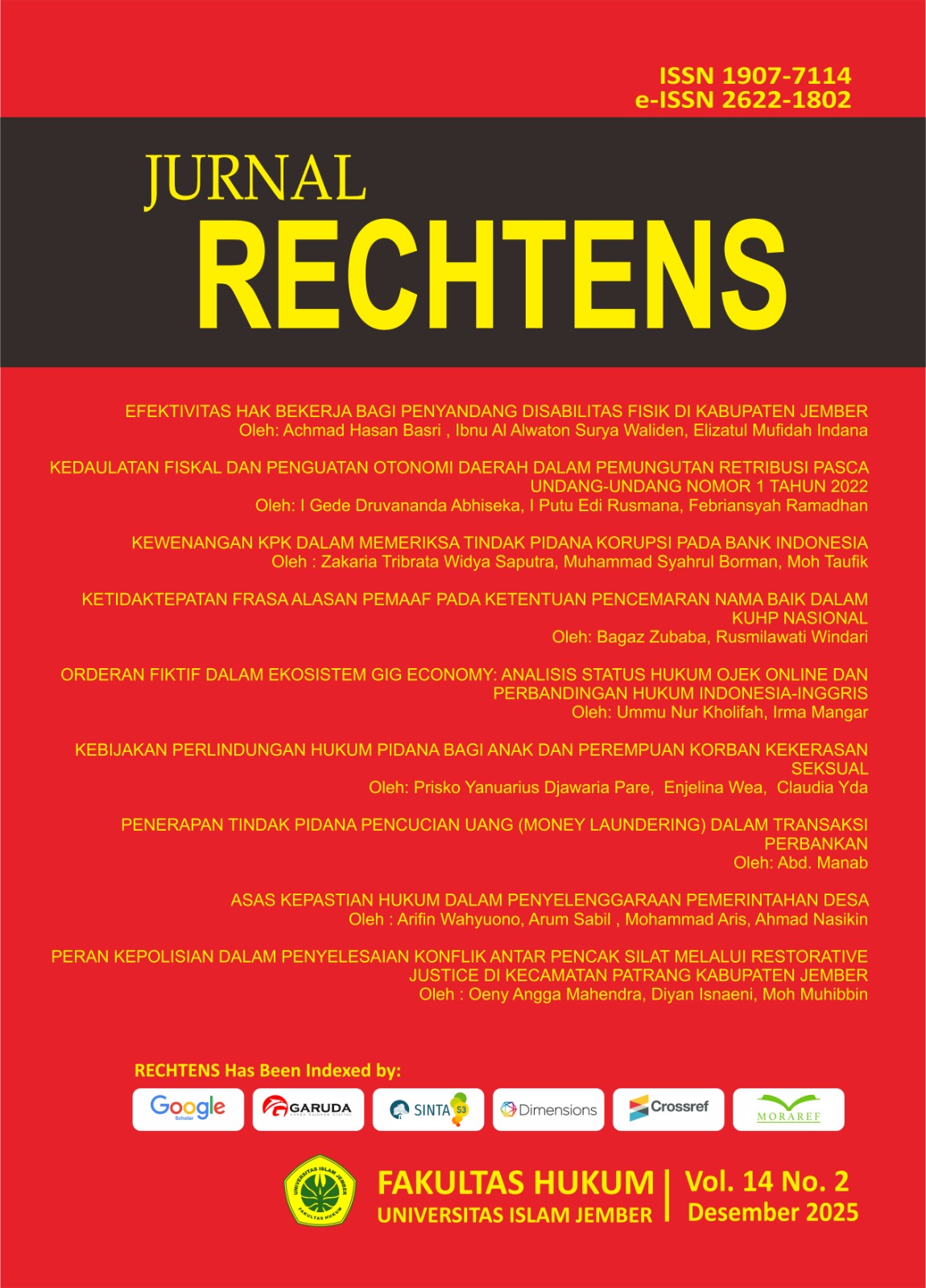
Kewenangan KPK Dalam Memeriksa Tindak Pidana Korupsi Pada Bank Indonesia
DOI:
https://doi.org/10.56013/rechtens.v14i2.4951Keywords:
Bank Indonesia, Corruption, KPK, Social assistance, State finance.Abstract
The study analyzes the legal framework governing KPK’s authority, including Law Number 19 of 2019 on the KPK, the Anti-Corruption Law, and financial governance regulations related to the distribution of social assistance. Using a normative juridical method supported by statutory and conceptual approaches, this paper identifies the extent to which KPK can intervene in corruption cases involving state financial management within independent state institutions such as Bank Indonesia. Findings show that the KPK holds strong legal authority to investigate corruption offenses, especially when they involve potential state losses and violations of governance principles. The study also reveals several challenges, including coordination barriers among supervisory institutions and the complexity of Bank Indonesia’s internal mechanisms. This article contributes to the discourse on strengthening anti-corruption mechanisms in Indonesia and highlights the urgency of improving transparency and accountability in the management of national social assistance funds.
Downloads
References
Jurnal
Alfedo, Juan Maulana, and Rama Halim Nur Azmi. “Sistem Informasi Pencegahan Korupsi Bantuan Sosial (Si Pansos) Di Indonesia: Rumusan Konsep Dan Pengaturan.” Integritas: Jurnal Antikorupsi 6, no. 2 SE-Articles (n.d.): 283–96. https://doi.org/10.32697/integritas.v6i2.668.
Andersson, Staffan, and Frank Anechiarico. “Corruption Control in Public Administration.” Corruption and Corruption Control. Routledge, 2019. https://doi.org/10.4324/9781351206990-4.
Anwar, and Fathur Rauzi. “Acceleration of the Role of the KPK in Prevention and Eradication of Corruption Criminal Acts Post Amendment to Law Number 19 of 2019.” HERMENEUTIKA 7, no. 1 (2023): 45–54. https://doi.org/https://doi.org/10.33603/hermeneutika.v6i3.8346.
Arief, Muhammad. “Analisis Perubahan Undang-Undang KPK: Dampak Terhadap Independensi Komisi Pemberantasan Korupsi (KPK) Di Indonesia.” Definisi: Jurnal Agama Dan Sosial Humaniora 2, no. 2 SE-Articles (August 19, 2023): 112–18. https://doi.org/10.1557/djash.v2i2.31925.
Ayuningtyas, Dumilah, Humaatul Islam, Sahfira Ulfa Hasibuan, Cindy Margaretha, Naurah Naziihah, Nisa’atul Maharanita Fitrianingrum, Ayudina Larasanti, and Qurrata Ayuni. “Implementasi Bantuan Sosial Pada Era Pandemi Covid-19: Evaluasi Aspek Transparansi Dan Akuntabilitas.” Integritas : Jurnal Antikorupsi 8, no. 1 (2022): 51–62. https://doi.org/10.32697/integritas.v8i1.796.
Barizki, Rezzi Nanda, and Mayang Riyantie. “Konstruksi Realitas Integritas Komisi Pemberantasan Korupsi (KPK) Dalam Pemberitaan Media Online.” Jurnal Inovasi Ilmu Sosial Dan Politik (JISoP) 3, no. 1 (2021): 68. https://doi.org/10.33474/jisop.v3i1.9016.
Diansari, Rani Eka, Adiza Alhassan Musah, and Jaizah Binti Othman. “Factors Affecting Village Fund Management Accountability in Indonesia: The Moderating Role of Prosocial Behaviour.” Cogent Business & Management 10, no. 2 (December 12, 2023): 2219424. https://doi.org/10.1080/23311975.2023.2219424.
Heryadi, Dudy, and Denny Indra Sukmawan. “Integritas : Jurnal Antikorupsi Mengoptimalkan Koordinasi Dan Supervisi Antar Instansi Dalam Rangka Pemberantasan Korupsi.” Integritas: Jurnal Antikorupsi 9, no. 2 (2023): 213–28. https://jurnal.kpk.go.id/index.php/integritas/article/download/945/244/3993.
Makkarateng, Ma’adul Yaqien. “KAJIAN TERHADAP KEDUDUKAN KOMISI PEMBERANTASAN KORUPSI (KPK) PASCA REVISI UNDANG-UNDANG.” Bilancia: Jurnal Studi Ilmu Syariah Dan Hukum 16, no. 1 (2022): 59–78. https://doi.org/10.24239/blc.v16i1.889.
Miftahul Amin, Siboyanga Sabisa, Marilang, Ashabul Kahfi, Erlina, Istiqamah. “Corruption of Social Assistance Budget during The Covid-19 Pandemic.” Department of Law, Universitas Islam Negeri Alauddin Makassar Vol 6 No 3 (2024).
Saragih, Yasmirah Mandasari, and Muhammad Arif Sahlepi. “KEWENANGAN PENYADAPAN DALAM PEMBERANTASAN TINDAK PIDANA KORUPSI.” Hukum Pidana Dan Pembangunan Hukum 1, no. 2 (2019). https://doi.org/10.25105/hpph.v1i2.5467.
Simanjuntak, Martinus Alexander, Rifqi Fadlurrohim, Muhammad Faiz Ridho, Mutiara Maharani, Desi Hafizah, and M. Yamani. “ANALISIS HUKUM TERHADAP PENYALURAN DANA CSR BANK INDONESIA ANTARA KEPATUHAN REGULASI DAN DUGAAN KORUPSI.” Jurnal Hukum Dan Kewarganegaraan 12, no. 11 (2025). https://doi.org/https://doi.org/10.6679/ksnerh56.
Solihah, Ratnia, and Triono. “PERAN KPK DALAM MENGAWAL PENGALOKASIAN DANA BANTUAN SOSIAL DI MASA PANDEMI COVID-19.” Jurnal Tapis: Teropong Aspirasi Politik Islam 16 16, no. 2 (2020): 69–80. https://doi.org/https://doi.org/10.24042/tps.v16i2.7764.
Sudarto, Sudarto. “RETRACTION NOTICE: Model Kolaborasi Antar-Lembaga Dan Reformasi Tata Kelola Keamanan Maritim Dalam Menjaga Kedaulatan Indonesia Pasca Reformasi.” JURNAL USM LAW REVIEW 7, no. 3 (2024): 1260–71. https://doi.org/10.26623/julr.v7i3.8912.
Susanto, Mei, Mario Angkawidjaja, and Susi Harijanti. “Teoretisasi Konstitusionalisme Moneter Di Indonesia Dalam Bingkai Pluralisme Konstitusi: Theorizing Monetary Constitutionalism in Indonesia through Constitutional Pluralism.” Jurnal Konstitusi 22 (2025): 206–28. https://doi.org/10.31078/jk2221.
Vasicek, Osvald, Natalie Uhrova, Lenka Dimitriou Janickova, Tomas Wroblowsky, and Boris Navratil. “Central Bank Independence: Where Do We Stand?” Economies 11, no. 4 (2023). https://doi.org/10.3390/economies11040109.
Wahib. “Memaknai Independensi KPK Pasca Perubahan Kedua Undang-Undang Republik Indonesia Nomor 19 Tahun 2019 Atas Undang-Undang Nomor 30 Tahun 2002 Tentang Komisi Pemberantasan Korupsi.” Jurnal Ilmu Hukum 5, no. 2 (2022): 68–77. https://doi.org/https://doi.org/10.32493/rjih.v5i1.23776.
Wijaya, Rafael Christian. “Peran Media Sosial Dalam Pengawasan Dan Pencegahan Korupsi Di Indonesia.” Birokrasi: JURNAL ILMU HUKUM DAN TATA NEGARA 2, no. 4 (2024): 271–79. https://doi.org/10.55606/birokrasi.v2i4.1657.
Buku
Asshiddiqie, J. Perkembangan Dan Konsolidasi Lembaga Negara Pasca Reformasi. Konstitusi Press, 2008.
Cukierman, A. Central Bank Strategy, Credibility and Independence. MIT Press, 1992.
Djaja, E. Memberantas Korupsi Bersama KPK. Prenada Media, 2019.
Effendy, M. Teknik Penyidikan Dan Penuntutan Tindak Pidana Korupsi. Sinar Grafika, 2018.
Indonesia Corruption Watch. Tren Korupsi Pada Lembaga Negara Independen. ICW Research Report, 2023.
KPK RI. Laporan Tahunan Komisi Pemberantasan Korupsi, 2021.
Miftahul Amin, Siboyanga Sabisa, Marilang, Ashabul Kahfi, Erlina, Istiqamah. “Corruption of Social Assistance Budget during The Covid-19 Pandemic.” Department of Law, Universitas Islam Negeri Alauddin Makassar Vol 6 No 3 (2024).
Muslimah, Defi. Fungsi Koordinasi KPK Dan Kejaksaan Agung Dalam Penanganan Tindak Pidana Korupsi. Penerbit NEM, 2021.
OECD. Oversight of Independent Public Institutions. OECD Governance Papers, 2017.
PPATK. Laporan Analisis Transaksi Keuangan Kasus Korupsi Dana Sosial, 2022.
Rahardjo, S. Hukum Progresif. Kompas Media, 2009.
Peraturan Perundang-undangan
Republik Indonesia. Undang-Undang Nomor 17 Tahun 2003 tentang Keuangan Negara (2003).
Republik Indonesia. Undang-Undang Nomor 20 Tahun 2001 tentang Perubahan atas UU Tipikor (2001).
Republik Indonesia. Undang-Undang Nomor 31 Tahun 1999 tentang Pemberantasan Tindak Pidana Korupsi (1999).
Republik Indonesia. Undang-Undang Nomor 6 Tahun 2009 tentang Bank Indonesia (2009).
Downloads
Published
How to Cite
Issue
Section
License
Copyright (c) 2025 Zakaria Tribrata Widya Saputra, Muhammad Syahrul Borman, Moh. Taufik

This work is licensed under a Creative Commons Attribution-ShareAlike 4.0 International License.