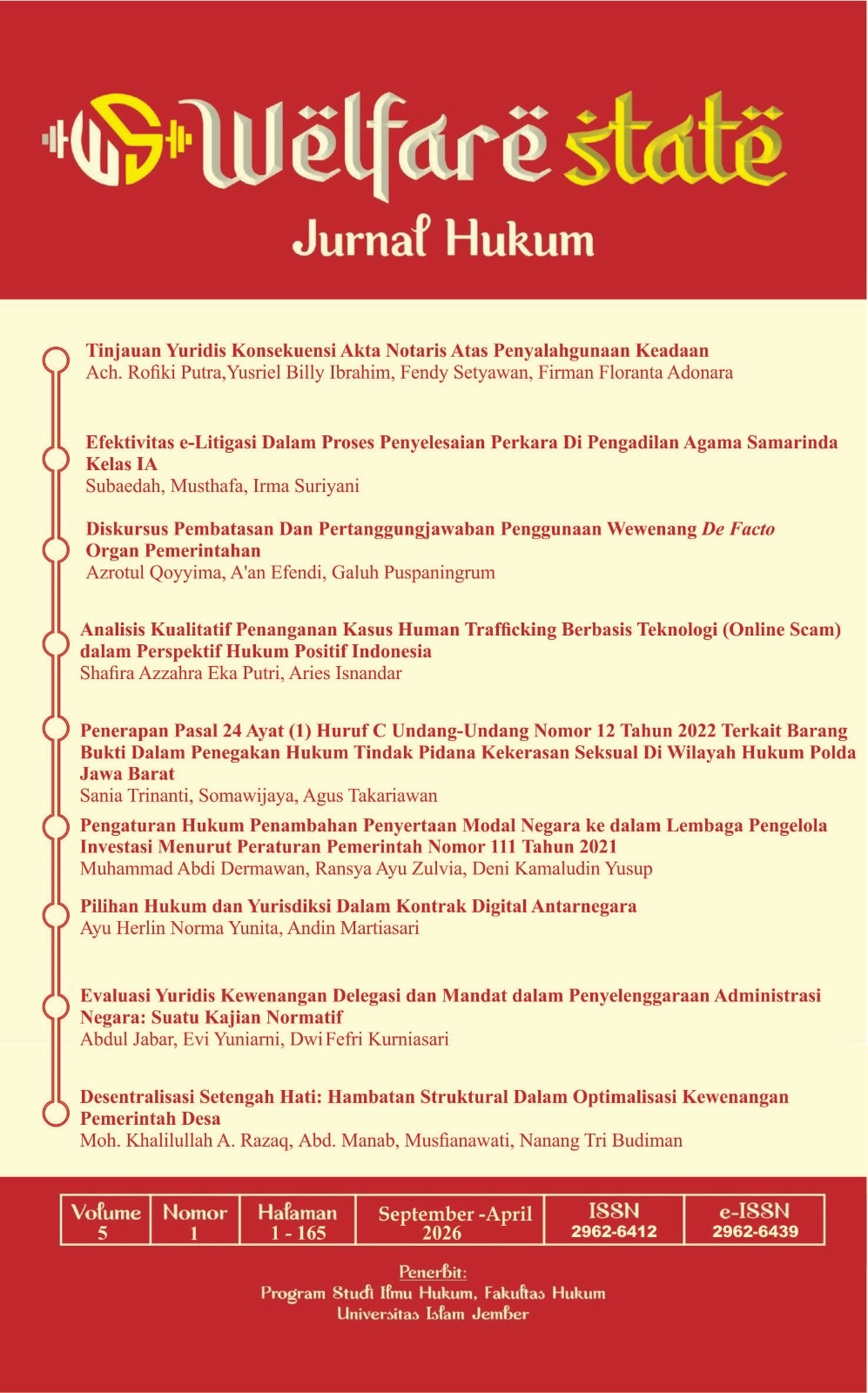
Efektivitas e-Litigasi Dalam Proses Penyelesaian Perkara Di Pengadilan Agama Samarinda Kelas IA
DOI:
https://doi.org/10.56013/welfarestate.v5i1.4852Keywords:
Effectiveness; E-Litigation; Religious Justice.Abstract
This abstract aims to determine the effectiveness of e-Litigation in the case resolution process at the Samarinda Religious Court Class IA. This research uses a qualitative-descriptive socio-legal approach. The data sources used are primary data sources obtained directly from the first source and secondary data sources obtained from primary, secondary, and tertiary legal materials. Primary data collection techniques are interviews and secondary data with literature studies, data analysis techniques with interactive analysis models. The results of the study show that the implementation of e-Litigation at the Samarinda Religious Court Class IA has been running in accordance with PERMA No. 7 of 2022 concerning Amendments to PERMA No. 1 of 2019 concerning Case Administration and Trials in Courts Electronically but is not fully optimal. This is due to several factors, including technological infrastructure and uneven understanding of digital literacy among justice-seeking communities. However, e-Litigation makes a positive contribution to the efficiency of time and cost of case resolution.