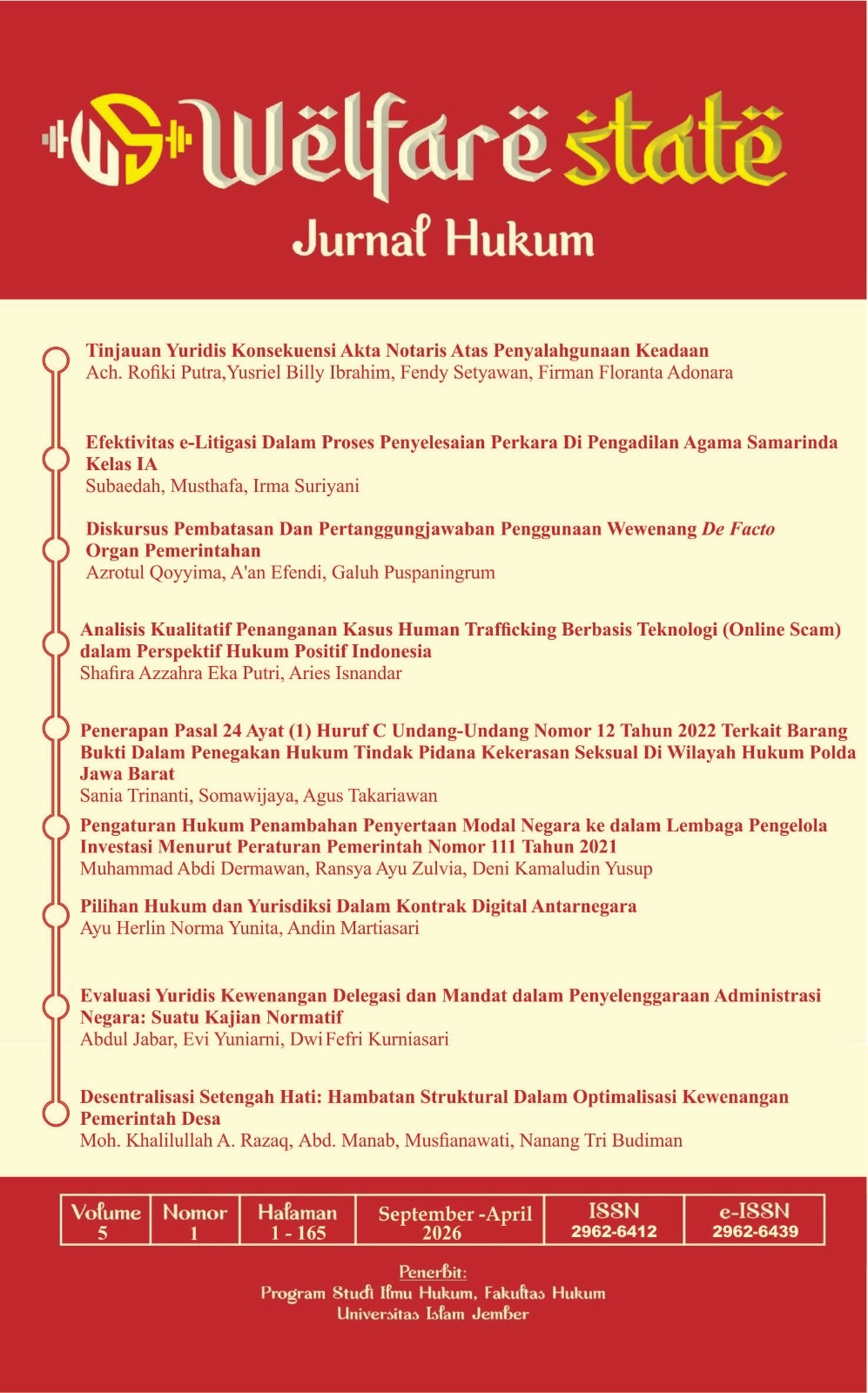
Diskursus Pembatasan Dan Pertanggungjawaban Penggunaan Wewenang De Facto Organ Pemerintahan
DOI:
https://doi.org/10.56013/welfarestate.v5i1.5005Keywords:
De facto authority, Government organs, General Principles of Good Governance.Abstract
This article examines the theoretical and normative construction of the use of de facto authority in the Indonesian administrative law system, particularly in relation to the limits of its use and the forms of accountability attached to government institutions. This study uses normative legal research. The discussion concludes that the use of de facto authority generally arises due to emergency conditions, normative vacuums, or unclear regulations, which require government institutions to act to maintain the smooth running of public services and prevent government stagnation. Although it provides flexibility beyond the formal legal mandate, the use of de facto authority remains limited by the principles of legality, material, territorial, and temporal boundaries as stipulated in the Government Administration Law, as well as the obligation to comply with the Principles of Good Governance (AUPB). The study's findings show that every use of de facto authority always has legal consequences through two forms of accountability: (1) official accountability, when actions are taken in the context of carrying out legitimate government duties, and (2) personal accountability, when officials act improperly, abuse their authority, or commit maladministration. This article emphasises that de facto authority remains an important tool but can only be exercised if it complies with the AUPB.