Factors Shaping Pre-service Biology Teachers’ Acceptance of Generative Artificial Intelligence
DOI:
https://doi.org/10.56013/bio.v15i1.5552Keywords:
Educational Technology, Generative Artificial Intelligence,, PLS-SEM, Pre-service biology teacher, Technology Acceptance ModelAbstract
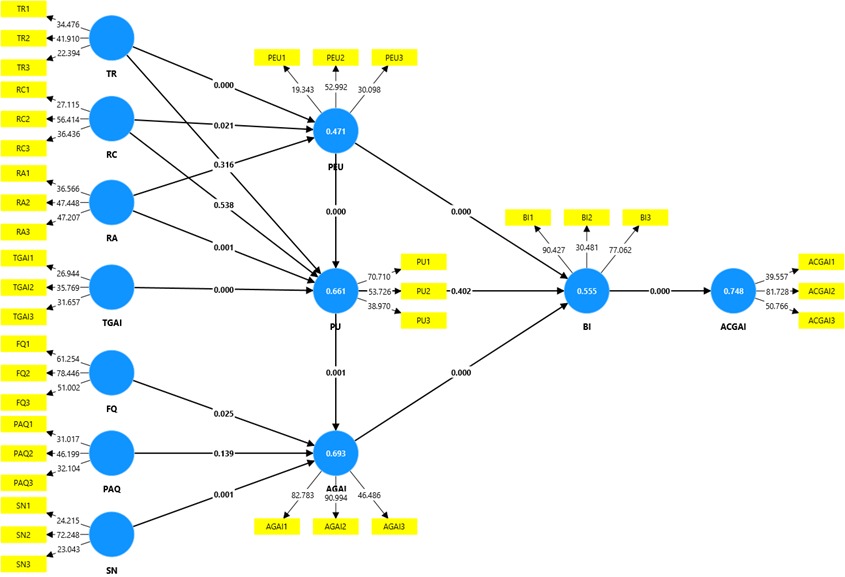
The rapid diffusion of generative artificial intelligence (GAI) has introduced new opportunities and challenges for teacher education, particularly within STEM disciplines, specifically biology education. This study investigates the determinants of generative AI acceptance among Generation Z pre-service biology teachers by integrating constructs from the Technology Acceptance Model and Diffusion of Innovation theory with pedagogically grounded variables. Using a quantitative cross-sectional survey design, data were collected from 318 pre-service biology teachers enrolled at two Indonesian universities. Partial least squares structural equation modeling (PLS-SEM) was employed to examine the relationships among trialability, relative advantage, perceived compatibility, trust, feedback quality, perceived assessment quality, subjective norms, perceived ease of use, perceived usefulness, attitude, behavioral intention, and acceptance of generative AI. The results indicate that trialability, relative advantage, and compatibility significantly predict perceived ease of use, while relative advantage and trust significantly influence perceived usefulness. Feedback quality and subjective norms positively shape attitudes toward generative AI, whereas perceived assessment quality shows no significant effect. Perceived ease of use and attitude emerge as key predictors of behavioral intention, which strongly determines acceptance. The findings highlight the central roles of affective, social, and trust-related factors in shaping generative AI adoption among future biology teachers. This study contributes to the emerging literature on AI in STEM teacher education and offers practical implications for designing pedagogically meaningful and responsible AI integration in teacher preparation programs.
References
Abdaljaleel, M., Barakat, M., Alsanafi, M., Salim, N. A., Abazid, H., Malaeb, D., ... & Sallam, M. (2024). A multinational study on the factors influencing university students’ attitudes and usage of ChatGPT. Scientific Reports, 14(1), 1983.
Acosta-Enriquez, B. G., Arbulú Ballesteros, M. A., Arbulu Perez Vargas, C. G., Orellana Ulloa, M. N., Gutiérrez Ulloa, C. R., Pizarro Romero, J. M., ... & López Roca, C. (2024). Knowledge, attitudes, and perceived Ethics regarding the use of ChatGPT among generation Z university students. International Journal for Educational Integrity, 20(1), 10.
Agathokleous, E., Saitanis, C. J., Fang, C., & Yu, Z. (2023). Use of ChatGPT: What does it mean for biology and environmental science?. Science of The Total Environment, 888, 164154.
Agusalim, L. (2025). Smart PLS 4 for Smart Facilitators: Optimizing PLS-SEM Analysis in TKMP Program. GUYUB: Journal of Community Engagement, 6(2), 415-438.
Akpan, I. J., Kobara, Y. M., Owolabi, J., Akpan, A. A., & Offodile, O. F. (2025). Conversational and generative artificial intelligence and human–chatbot interaction in education and research. International Transactions in Operational Research, 32(3), 1251-1281.
Albadarin, Y., Saqr, M., Pope, N., & Tukiainen, M. (2024). A systematic literature review of empirical research on ChatGPT in education. Discover Education, 3(1), 60.
Al-kfairy, M. (2024). Factors impacting the adoption and acceptance of ChatGPT in educational settings: A narrative review of empirical studies. Applied System Innovation, 7(6), 110.
Almogren, A. S., Al-Rahmi, W. M., & Dahri, N. A. (2024). Exploring factors influencing the acceptance of ChatGPT in higher education: A smart education perspective. Heliyon, 10(11).
Baig, M. I., & Yadegaridehkordi, E. (2024). ChatGPT in the higher education: A systematic literature review and research challenges. International journal of educational research, 127, 102411.
Bloomfield, J., & Fisher, M. J. (2019). Quantitative research design. Journal of the Australasian Rehabilitation Nurses Association, 22(2), 27-30.
Chaushi, B. A., Ismaili, F., & Chaushi, A. (2024). Pros and cons of artificial intelligence in education. International Journal of Advanced Natural Sciences and Engineering Researches, 8(2), 51-57.
Chen, J., Xie, W., Xie, Q., Hu, A., Qiao, Y., Wan, R., & Liu, Y. (2025). A systematic review of user attitudes toward GenAI: Influencing factors and industry perspectives. Journal of Intelligence, 13(7), 78.
Dewi, H. R., Qudratuddarsi, H., Ningthias, D. P., & Cinthami, R. D. D. (2024). The Current Update of ChatGPT Roles in Science Experiment: A Systemic Literature Review. Saqbe: Jurnal Sains dan Pembelajarannya, 1(2), 74-85.
Elizondo-García, M. E., Hernández-De la Cerda, H., Benavides-García, I. G., Caratozzolo, P., & Membrillo-Hernández, J. (2025). Who is solving the challenge? The use of ChatGPT in mathematics and biology courses using challenge-based learning. In Frontiers in Education (Vol. 10, p. 1417642). Frontiers Media SA.
Gao, B., Liu, R., & Chu, J. (2025, May). Exploring Trends of Acceptance of Artificial Intelligence in Education: A Systematic Literature Review. In International Conference on Human-Computer Interaction (pp. 196-213). Cham: Springer Nature Switzerland.
Ghanbar, H. (2024). Using SmartPLS for structural equation modeling in applied linguistics: a method note. Educational Methods & Psychometrics, 2, 0-0.
Hair, J., Hult, G. T. M., Ringle, C. M., et al. (2022). PLS-SEM book: A primer on PLS-SEM (3rd ed.). Thousand Oaks: Sage.
Hsiao, C. H., & Tang, K. Y. (2025). Beyond acceptance: an empirical investigation of technological, ethical, social, and individual determinants of GenAI-supported learning in higher education. Education and Information Technologies, 30(8), 10725-10750.
Kurniawan, A., Hariyadi, S., Prabowo, A. S., & Savira, N. I. I. (2024). The Perceptions of the Pre-service and In-service Biology Teachers on Artificial Intelligence in Biology Learning. International Journal of Biology Education Towards Sustainable Development, 4(1), 1-8.
Lee, H. Y., Chen, P. H., Wang, W. S., Huang, Y. M., & Wu, T. T. (2024). Empowering ChatGPT with guidance mechanism in blended learning: Effect of self-regulated learning, higher-order thinking skills, and knowledge construction. International Journal of Educational Technology in Higher Education, 21(1), 16.
Lee, G. G., & Zhai, X. (2024). Using ChatGPT for science learning: A study on pre-service teachers' lesson planning. IEEE Transactions on Learning Technologies, 17, 1643-1660.
Li, M. (2025). Integrating artificial intelligence in primary mathematics education: Investigating internal and external influences on teacher adoption. International Journal of Science and Mathematics Education, 23(5), 1283-1308.
Maita, I., Saide, S., Putri, A. M., & Muwardi, D. (2024). Pros and cons of artificial intelligence–ChatGPT adoption in education settings: A literature review and future research agendas. IEEE Engineering Management Review, 52(3), 27-42.
Ozolins, U., Hale, S., Cheng, X., Hyatt, A., & Schofield, P. (2020). Translation and back-translation methodology in health research–a critique. Expert review of pharmacoeconomics & outcomes research, 20(1), 69-77.
Perera, P., Kulathunga, V. K., Perera, N. N., Gunarathna, A., Jayasinghe, P. S. K., & Rajamanthri, L. (2025). Adoption of ChatGPT in higher education: a systematic literature review of lecturers’ perspective based on UTAUT2. Asian Education and Development Studies, 1-25.
Qudratuddarsi, H., Fauziah, A., Agung, A., & Yanti, M. (2025). “Status Quo” Chatgpt Dalam Pengajaran Dan Pembelajaran Fisika: Systematic Literature Review. PHY, 110-118.
Qudratuddarsi, H., & Meivawati, E. (2025). AI Acceptance and Use In Mathematics Pre-Service Teachers: A Theory Of Planned Behaviour Approach. Mathematics Education and Application Journal (META), 7(2), 71-82.
Schei, O. M., Møgelvang, A., & Ludvigsen, K. (2024). Perceptions and use of AI chatbots among students in higher education: A scoping review of empirical studies. Education Sciences, 14(8), 922.
Stratton, S. J. (2021). Population research: convenience sampling strategies. Prehospital and disaster Medicine, 36(4), 373-374.
Vaithilingam, S., Ong, C. S., Moisescu, O. I., et al. (2024). Robustness checks in PLS-SEM: A review of recent practices and recommendations for future applications in business research. Journal of Business Research, 173, Article 114465.
Venugopal, K. (2024). Exploring Gen Z Perspectives Toward ChatGPT in Academic Contexts. In AI Algorithms and ChatGPT for Student Engagement in Online Learning (pp. 51-69). IGI Global Scientific Publishing.
Wang, X., & Cheng, Z. (2020). Cross-sectional studies: strengths, weaknesses, and recommendations. Chest, 158(1), S65-S71.
Wang, Y., Pi, T., & Xie, B. (2025). Exploring factors influencing pre-service teachers’ intention to use ChatGPT. Education and Information Technologies, 30(16), 23761-23790.
Downloads
Published
How to Cite
Issue
Section
License
Copyright (c) 2026 Evy Noviana, Ammar Ahadi Putra, Ratih Dhamayyana Dwi Cinthami, Hilman Qudratuddarsi

This work is licensed under a Creative Commons Attribution 4.0 International License.