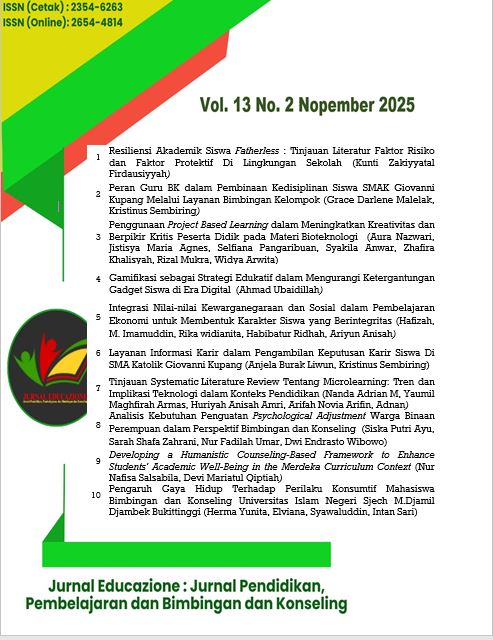
Developing a Humanistic Counseling-Based Framework to Enhance Students’ Academic Well-Being in the Merdeka Curriculum Context
DOI:
https://doi.org/10.56013/edu.v13i2.4968Keywords:
Academic Well-Being; Humanistic Counseling; Learning Autonomy; Merdeka Curriculum; Self-RegulationAbstract
This study aims to develop a humanistic counseling framework that is contextually aligned with the dynamics of the Merdeka Curriculum, particularly concerning the phenomena of autonomy overload, self-regulation pressure, and students’ emotional uncertainty. The research employed a qualitative method with a phenomenological approach through in-depth interviews, participatory observations, and school document analysis. The data were analyzed thematically using open coding, axial coding, and selective coding to produce a comprehensive theoretical construction. The findings indicate that the principles of humanistic counseling possess relational capacities that directly address the mechanistic challenges emerging within autonomy-based learning. This theoretical and empirical synthesis yields three core dimensions of the framework: Empathic-Autonomy Alignment, Academic Self-Actualization Support, and Reflective-Experiential Guidance. These dimensions work interdependently to strengthen healthy autonomy, enhance academic clarity, and stabilize students’ emotional well-being. The study offers a conceptual contribution to the development of school counseling models that are relevant to the needs of contemporary education in Indonesia.
References
Abd Rahim, & Bambang Ismaya. (2023). Pendidikan Karakter dalam Merdeka Curriculum Belajar: Tantangan dan Peluang. Journal Sains and Education, 1(3).
Ahmad Shofi Mubarok, Neneng Mukaffa Opier, Irene Hendrika Ramopoly, Loso Judijanto, & Junizar Junizar. (2025). Psikologi: Stres Akademik dan Penanganannya. PT. Sonpedia Publishing Indonesia.
Aji Wicaksono, Christian Karrel, & Retno Palupi. (2025). Dampak Gadget Dalam Kesehatan Mental . Jurnal Solo Teknologi, 1(2), 50–53.
Allysha Syatifa Fitriana. (2025). Efektivitas Konseling Integratif dalam Mengurangi Stres Akademik pada Pelajar SMA. Jurnal Bimbingan Konseling, 3(1).
Amanda Dewi Nadila, Octaviani Lestari, & Faelasup. (2025). Pengalaman Siswa dalam Mengikuti Pembelajaran Proyek (Project-Based Learning) pada Merdeka Curriculum. Jurnal Pendidikan Dan Pembelajaran, 4(2), 338–346.
Apriyanto, A., Haddar, G. Al, Mardiati, M., & Sitepu, E. (2025). Pengaruh Self-Regulated Learning terhadap Kemampuan Berpikir Kritis Siswa di Indonesia. Sanskara Pendidikan Dan Pengajaran, 3(02), 70–80. https://doi.org/10.58812/spp.v3i02.561
Asmare, M. A., Yimer, B. M., & Mesfin Molla, D. (2025). Exploring factors influencing secondary school teachers’ engagement in reflective teaching. Reflective Practice, 26(1), 39–54. https://doi.org/10.1080/14623943.2024.2412879
Aysah, N., Muslimah, M., & Hidayati, S. (2025). Karakter Disiplin dalam Membangun Self Regulation Learning Siswa di SMAN 2 Palangka Raya. Jurnal Ilmiah Global Education, 6(2), 810–823. https://doi.org/10.55681/jige.v6i2.3904
Babinski, L. M., Murray, D. W., & Hamm, J. V. (2023). Self-Regulation Challenges and Supports in Middle Level Education: Health Education Teachers’ and School Counselors’ Views. RMLE Online, 46(6), 1–16. https://doi.org/10.1080/19404476.2023.2204780
Bee, C. C., & Madrigal, R. (2013). Consumer uncertainty: The influence of anticipatory emotions on ambivalence, attitudes, and intentions. Journal of Consumer Behaviour, 12(5), 370–381. https://doi.org/10.1002/cb.1435
Beliyawati, B., Pahrudin, A., & Rahmi, S. (2025). MODEL, KONSEP, DESAIN, PENDEKATAN DAN MODEL PENGEMBANGAN KURIRKULUM. SOCIAL : Jurnal Inovasi Pendidikan IPS, 5(2), 317–325. https://doi.org/10.51878/social.v5i2.5378
Boekaerts, M. (1991). Subjective competence, appraisals and self-assessment. Learning and Instruction, 1(1), 1–17. https://doi.org/10.1016/0959-4752(91)90016-2
Burks, D. J., & Robbins, R. (2012). Psychologists’ Authenticity. Journal of Humanistic Psychology, 52(1), 75–104. https://doi.org/10.1177/0022167810381472
Endah Saadah, & Hanafiah. (2024). Diferensiasi Strategi Dan Metode Pendampingan Pengawas Sekolah Terhadap Kepala Sekolah Dalam Implementasi Merdeka Curriculum. PT Arr Rad Pratama.
Hilliard, J., Kear, K., Donelan, H., & Heaney, C. (2020). Students’ experiences of anxiety in an assessed, online, collaborative project. Computers & Education, 143, 103675. https://doi.org/10.1016/j.compedu.2019.103675
I Wayan Indra Praekanata. (2024). Inovasi Konseling Berbasis Pendekatan Holistik. PT Nilacakra Publishing House.
Khotimah, R., & Nurjannah, N. (2024). IMPLEMENTASI ZIKIR SEBAGAI UPAYA MEREDUKSI CEMAS MELALUI PENDEKATAN COGNITIVE BEHAVIORAL THERAPY (CBT). At-Taujih : Bimbingan Dan Konseling Islam, 7(1), 57. https://doi.org/10.22373/taujih.v7i1.18757
Kusumawati, A. A. (2024). SELF REGULATION DALAM MENINGKATKAN MOTIVASI BELAJAR PESERTA DIDIK. Jurnal EMPATI, 13(3), 47–52. https://doi.org/10.14710/empati.2024.45013
Lalu Rifki Sanjaya, M Zaky Fauzan Lubis, & Gusman Lesmana. (2025). Pendekatan Humanistik Dalam Konseling: Meningkatkan Keterampilan Emosional Siswa. Al-Iman Jurnal Keislaman Dan Kemasyarakatan , 9(1), 209–218.
Mahesanara, A. A., & Nastiti, D. (2024). HUBUNGAN ANTARA SCHOOL WELL BEING DAN SELF REGULATED LEARNING PADA SISWA SMPN 2 TAMAN. Psikologia : Jurnal Psikologi, 9(2), 114–123. https://doi.org/10.21070/psikologia.v11i2.1816
Muh Husyain Rifai, Oktovianus Mamoh, Vincentius Mauk, Kristina E. Noya Nahak, Haswinda Harpriyanti, Maria Magdalena Namok Nahak, Umar, Sri Rejeki, Febronia Lasi, Dwi Muvida Jaya, M.Biomed, & Irwan Abbas. (2024). Merdeka Curriculum (Implementasi dan Pengaplikasian). Selat Media.
Munawar, Moh. (2022). Merdeka Belajar. JURNAL PEDAGOGY, 15(2), 137–149. https://doi.org/10.63889/pedagogy.v15i2.144
Pramana, I. B. G. A. Y., Putri, P. R. A., Winayanti, R. D., Anggreni, N. W. Y., Wistarini, N. N. I. P., & Pratidina, P. A. O. (2025). Peran Regulasi Emosi sebagai Moderator dalam Hubungan antara Stres Akademik dan Cyberslacking: Tantangan Sosial di Era Digital. Jurnal Humanitas: Katalisator Perubahan Dan Inovator Pendidikan, 11(2), 249–263. https://doi.org/10.29408/jhm.v11i2.29601
Priyadarshini, A., Sanyal, D., & Sindhu Vasanth, B. (2025). Integration of Social and Psychological Perspectives in Education. In Shaping Childhood Through Educational Experiences (pp. 55–104). IGI Global. https://doi.org/10.4018/979-8-3693-9969-9.ch003
Proctor, C., Tweed, R. G., & Morris, D. B. (2021). Unconditional positive self-regard: The role of perceived parental conditional regard. The Humanistic Psychologist, 49(3), 400–422. https://doi.org/10.1037/hum0000168
Putri Masayu Asahri, & Sartono Sartono. (2025). Analisis Kesehatan Mental Pelajar di Era Pembelajaran Digital. Morfologi : Jurnal Ilmu Pendidikan, Bahasa, Sastra Dan Budaya, 3(3), 243–251. https://doi.org/10.61132/morfologi.v3i3.1704
Rahmi Hayati, & Ida Wahyu Wijiyati. (2025). Asesmen Pembelajaran: Teori dan Praktik. PT Sada Kurnia Pustaka.
Sartika, M., Hartono, M. O., & Yarni, L. (2025). Teori Belajar Humanistik. Invention: Journal Research and Education Studies, 613–627. https://doi.org/10.51178/invention.v6i2.2705
Siti Zubaidah. (2020). Self Regulated Learning: Pembelajaran dan Tantangan pada Era Revolusi Industri 4.0 . Prosiding SNPBS (Seminar Nasional Pendidikan Biologi Dan Saintek), 1–19.
Stefanou, C., Stolk, J. D., Prince, M., Chen, J. C., & Lord, S. M. (2013). Self-regulation and autonomy in problem- and project-based learning environments. Active Learning in Higher Education, 14(2), 109–122. https://doi.org/10.1177/1469787413481132
Sukmawati, S., Sufyadi, S., Utama, A. H., & Mastur, M. (2024). Pemanfaatan Media Short Video Learning untuk Mendukung Pembelajaran Metode Self-Paced Learning. Journal of Education Research, 5(4), 6255–6265. https://doi.org/10.37985/jer.v5i4.1935
Susanto, C., Hastuti, R., & Tiofanny, J. (2024). Kaitan Motivasi Akademik dan School Well-being Siswa SMA yang Menggunakan Merdeka Curriculum Belajar. EDUKATIF : JURNAL ILMU PENDIDIKAN, 6(3), 2498–2506. https://doi.org/10.31004/edukatif.v6i3.6867
Thomas, J., & Harden, A. (2008). Methods for the thematic synthesis of qualitative research in systematic reviews. BMC Medical Research Methodology, 8(1), 45. https://doi.org/10.1186/1471-2288-8-45
Windy Ana Fitriyanti. (2025). KONSEP STRES AKADEMIK DAN IMPLIKASINYA TERHADAP PERILAKU BELAJAR SISWA . Al-Kindi: Jurnal Pendidikan Islam Multidisipliner, 1(1), 1–15.
Yeni Apriyanti, & Dzifa Hesti Hazal Wardhani. (2025). Pengaruh Teknik Konseling Terhadap Perubahan Motivasi Belajar Siswa: Sebuah Pendekatan Kualitatif. Jurnal Fokus Konseling, 11(2), 173–182.
Zidan Fahman Arbi, & Amrullah Amrullah. (2024). Transformasi Sosial dalam Pendidikan Karakter di Era Digital: Peluang dan Tantangan. Social Studies in Education, 2(2), 191–206. https://doi.org/https://doi.org/10.15642/sse.2024.2.2.191-206
Downloads
Published
How to Cite
Issue
Section
License
Copyright (c) 2025 Nur Nafisa Salsabila

This work is licensed under a Creative Commons Attribution 4.0 International License.












 a
a