Isolasi, Identifikasi, dan Bioaktivitas Jamur Endofit Akar Cabai Rawit sebagai Biokontrol dan Pemacu Pertumbuhan
DOI:
https://doi.org/10.56013/bio.v15i2.5603Keywords:
Jamur endofit, Biokontrol, Colletotrichum capsici, IAA, Cabai rawitAbstract
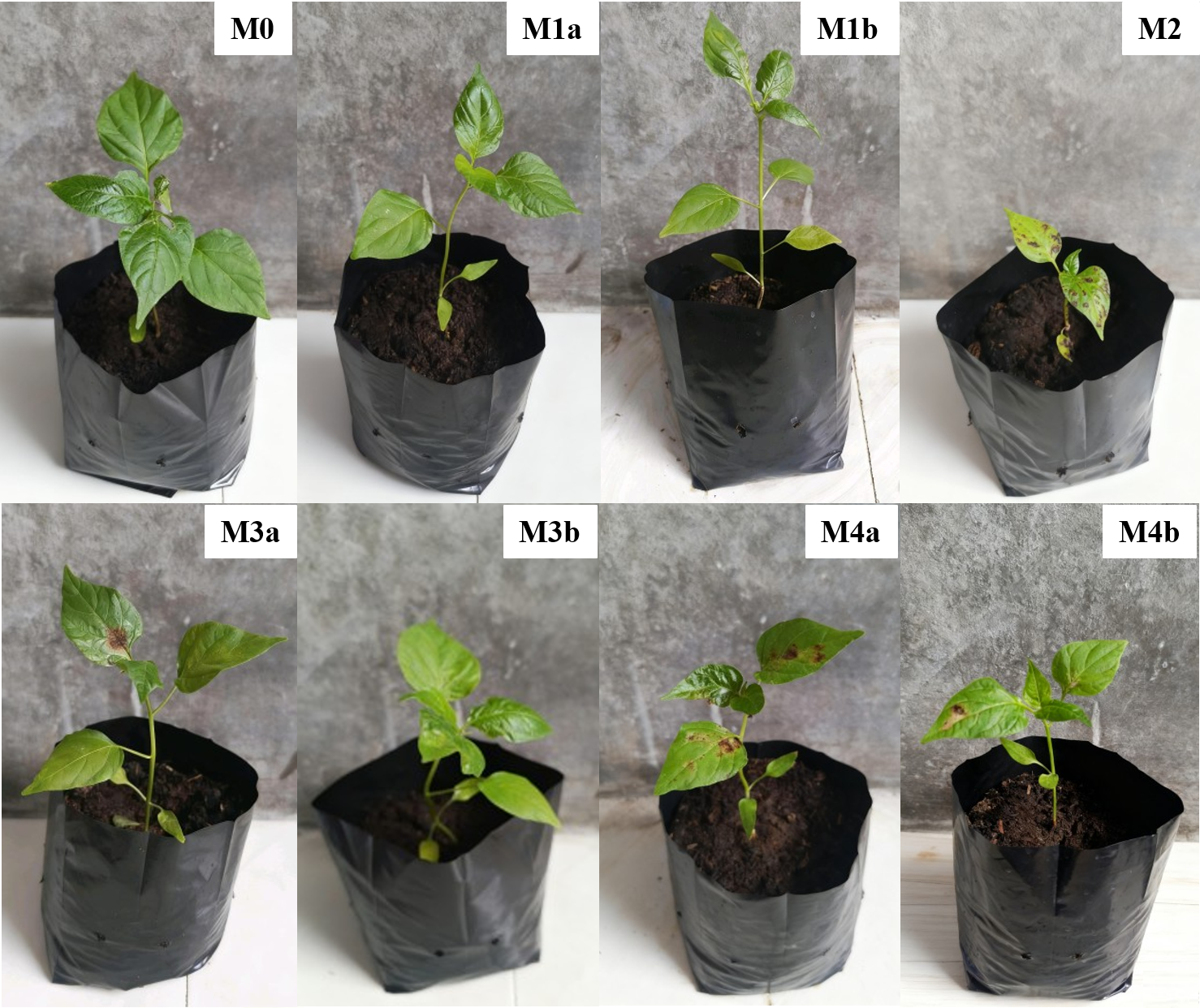
Penelitian ini dilakukan untuk mengisolasi serta mengarakterisasi jamur endofit dari jaringan akar cabai rawit (Capsicum frutescens L.), serta mengevaluasi bioaktivitasnya sebagai agen biokontrol terhadap C. capsici dan sebagai pemacu pertumbuhan tanaman. Isolasi dilakukan menggunakan metode kultur jaringan tanaman, diikuti dengan identifikasi secara makroskopis dan mikroskopis. Uji aktivitas biokontrol dilakukan melalui metode dual culture, sedangkan kemampuan produksi Indole Acetic Acid (IAA) diuji menggunakan reagen Salkowski. Pengujian in vivo dilakukan untuk menilai kemampuan isolat dalam menekan keparahan penyakit dan meningkatkan pertumbuhan tanaman cabai rawit. Hasil penelitian menunjukkan bahwa beberapa isolat jamur endofit memiliki aktivitas antagonis terhadap C. capsici, dengan salah satu isolat (E2) menunjukkan daya hambat tertinggi. Isolat tersebut juga mampu memproduksi IAA dan memberikan pengaruh positif terhadap pertumbuhan tanaman, yang ditunjukkan oleh peningkatan parameter tinggi tanaman, jumlah daun, dan berat basah. Selain itu, aplikasi isolat E2 secara nyata menurunkan tingkat keparahan penyakit dibandingkan kontrol. Hasil ini mengindikasikan bahwa jamur endofit berpotensi sebagai agen biokontrol sekaligus pemacu pertumbuhan tanaman cabai rawit yang ramah lingkungan.
Kata kunci: Jamur endofit, Biokontrol, Colletotrichum capsici, IAA, Cabai rawit
References
Agrios, G. N. (2005). Plant pathology (5th ed.). Elsevier Academic Press.
Alfiky, A., & Weisskopf, L. (2021). Deciphering Trichoderma–Plant–Pathogen Interactions for Better Development of Biocontrol Applications. Journal of Fungi, 7(1), 61. https://doi.org/10.3390/jof7010061
Ansabayeva, A., Makhambetov, M., Rebouh, N. Y., Abdelkader, M., Saudy, H. S., Hassan, K. M., Nasser, M. A., Ali, M. A. A., & Ebrahim, M. (2025). Plant Growth-Promoting Microbes for Resilient Farming Systems: Mitigating Environmental Stressors and Boosting Crops Productivity—A Review. Horticulturae, 11(3), 260. https://doi.org/10.3390/horticulturae11030260
Arora, P., Tabssum, R., Gupta, A. P., Kumar, S., & Gupta, S. (2024). Optimization of indole acetic acid produced by plant growth promoting fungus, aided by response surface methodology. Heliyon, 10(14), e34356. https://doi.org/10.1016/j.heliyon.2024.e34356
Arnold, A. E., Mejía, L. C., Kyllo, D., Rojas, E. I., Maynard, Z., Robbins, N., & Herre, E. A. (2003). Fungal endophytes limit pathogen damage in a tropical tree. Proceedings of the National Academy of Sciences, 100(26), 15649–15654. https://doi.org/10.1073/pnas.2533483100
Backer, R., Rokem, J. S., Ilangumaran, G., Lamont, J., Praslickova, D., Ricci, E., Subramanian, S., & Smith, D. L. (2018). Plant growth-promoting rhizobacteria: Context, mechanisms of action, and roadmap to commercialization of biostimulants for sustainable agriculture. Frontiers in Plant Science, 9, 1473. https://doi.org/10.3389/fpls.2018.01473
Barnett, H. L., & Hunter, B. B. (1998). Illustrated genera of imperfect fungi (4th ed.). APS Press.
Benítez, T., Rincón, A. M., Limón, M. C., & Codón, A. C. (2004). Biocontrol mechanisms of Trichoderma strains. International Microbiology, 7(4), 249–260.
Compant, S., Duffy, B., Nowak, J., Clément, C., & Barka, E. A. (2005). Use of plant growth-promoting bacteria for biocontrol of plant diseases: Principles, mechanisms of action, and future prospects. Applied and Environmental Microbiology, 71(9), 4951–4959. https://doi.org/10.1128/AEM.71.9.4951-4959.2005
Dean, R., Van Kan, J. A. L., Pretorius, Z. A., Hammond-Kosack, K. E., Di Pietro, A., Spanu, P. D., Rudd, J. J., Dickman, M., Kahmann, R., Ellis, J., & Foster, G. D. (2012). The Top 10 fungal pathogens in molecular plant pathology. Molecular Plant Pathology, 13(4), 414–430. https://doi.org/10.1111/j.1364-3703.2011.00783.x
Dolatabadi, H. K., Goltapeh, E. M., & Jaimand, K. (2012). Biocontrol Potential of Root Endophytic Fungi and Trichoderma Species Against Fusarium Wilt of Lentil Under In Vitro and Greenhouse Conditions. Journal of Agriculture, Science and Technology. 14(2): 407-420.
Harman, G. E., Howell, C. R., Viterbo, A., Chet, I., & Lorito, M. (2004). Trichoderma species—Opportunistic, avirulent plant symbionts. Nature Reviews Microbiology, 2(1), 43–56. https://doi.org/10.1038/nrmicro797
Khalil, A.M.A., Hassan, S.E.-D., Alsharif, S.M., Eid, A.M., Ewais, E.E.-D., Azab, E., Gobouri, A.A., Elkelish, A., Fouda, A. (2021). Isolation and Characterization of Fungal Endophytes Isolated from Medicinal Plant Ephedra pachyclada as Plant Growth-Promoting. Biomolecules. 11(140): 1-19. https://doi.org/10.3390/biom11020140
Klich, M.A. 2002. Identification of common Aspergillus species. Amer Society for Microbiology.
Perfect, S. E., Hughes, H. B., O’Connell, R. J., & Green, J. R. (1999). Colletotrichum: A model genus for studies on pathology and fungal–plant interactions. Fungal Genetics and Biology, 27(2–3), 186–198. https://doi.org/10.1006/fgbi.1999.1143
Pieterse, C. M. J., Zamioudis, C., Berendsen, R. L., Weller, D. M., Van Wees, S. C. M., & Bakker, P. A. H. M. (2014). Induced systemic resistance by beneficial microbes. Annual Review of Phytopathology, 52, 347–375. https://doi.org/10.1146/annurev-phyto-082712-102340
Rodriguez, R. J., White, J. F., Arnold, A. E., & Redman, R. S. (2009). Fungal endophytes: Diversity and functional roles. New Phytologist, 182(2), 314–330. https://doi.org/10.1111/j.1469-8137.2009.02773.x
Savary, S., Willocquet, L., Pethybridge, S. J., Esker, P., McRoberts, N., & Nelson, A. (2019). The global burden of pathogens and pests on major food crops. Nature Ecology & Evolution, 3, 430–439. https://doi.org/10.1038/s41559-018-0793-y
Spaepen, S., Vanderleyden, J., & Remans, R. (2007). Indole-3-acetic acid in microbial and microorganism-plant signaling. FEMS Microbiology Reviews, 31(4), 425–448. https://doi.org/10.1111/j.1574-6976.2007.00072.x
Taiz, L., Zeiger, E., Møller, I. M., & Murphy, A. (2014). Plant physiology and development (6th ed.). Sinauer Associates.
Thambugala, K. M., Daranagama, D. A., Phillips, A. J. L., Kannangara, S. D., & Promputtha, I. (2020). Fungi vs. Fungi in Biocontrol: An Overview of Fungal Antagonists Applied Against Fungal Plant Pathogens. Frontiers in cellular and infection microbiology, 10, 604923. https://doi.org/10.3389/fcimb.2020.604923
White, J. F., Kingsley, K. L., Zhang, Q., Verma, R., Obi, N., Dvinskikh, S., Elmore, M. T., Verma, S. K., Gond, S. K., & Kowalski, K. P. (2019). Review: Endophytic microbes and their potential applications in crop management. Pest Management Science, 75(10), 2558–2565. https://doi.org/10.1002/ps.5527
Downloads
Published
How to Cite
Issue
Section
License
Copyright (c) 2026 Muhammad Zainul Wahid, Bambang Irawan, Rochmah Agustrina, Kusuma Handayani

This work is licensed under a Creative Commons Attribution 4.0 International License.