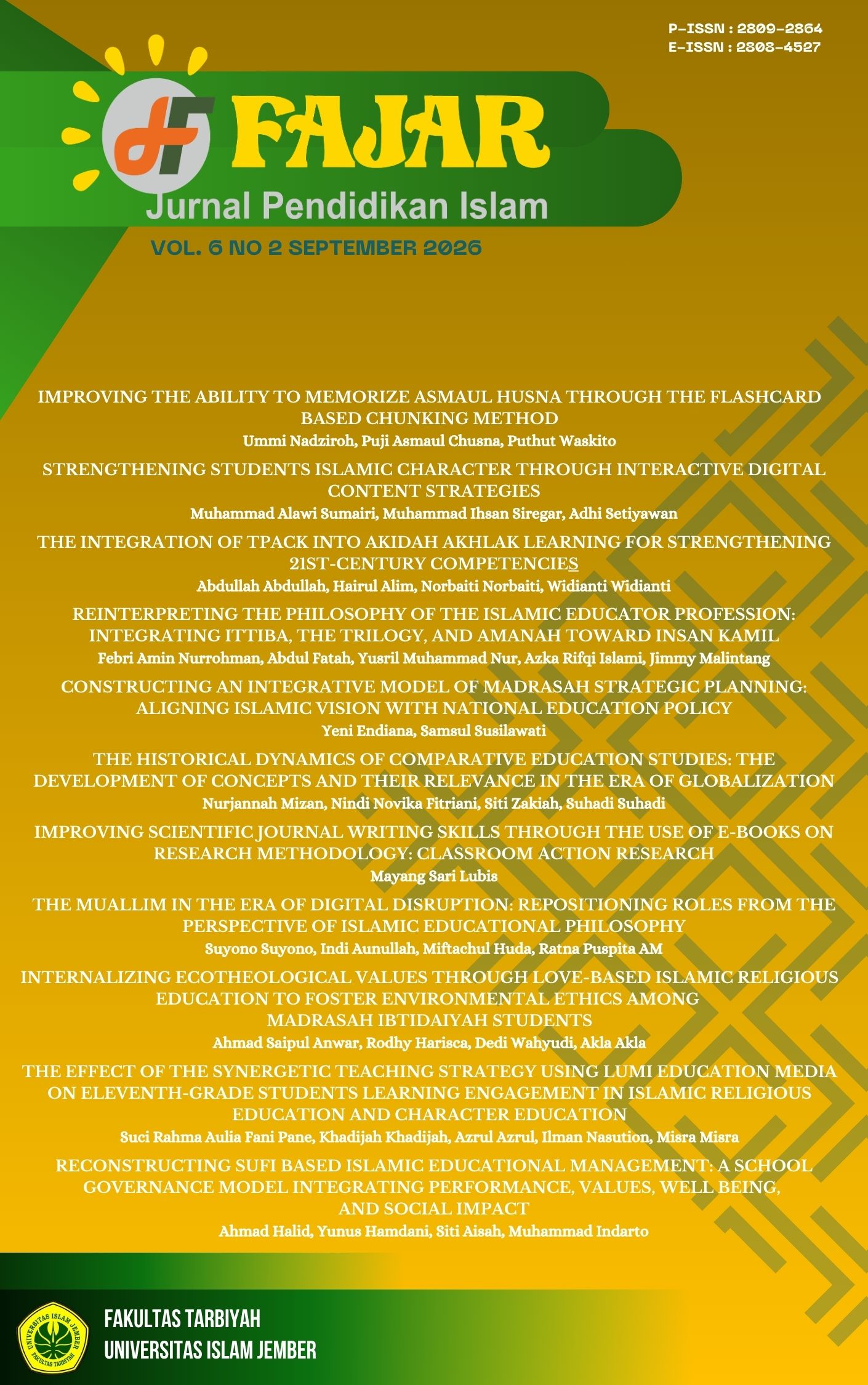
RECONSTRUCTING SUFI BASED ISLAMIC EDUCATIONAL MANAGEMENT: A SCHOOL GOVERNANCE MODEL INTEGRATING PERFORMANCE, VALUES, WELL BEING, AND SOCIAL IMPACT
DOI:
https://doi.org/10.56013/fj.v6i2.6519Keywords:
educational management, Sufi, school governance, social impactAbstract
School management in an era of rapid change faces increasingly complex challenges. Schools are required to deliver measurable academic performance, meet quality standards, develop teacher competencies, adaptively utilize technology, and produce graduates capable of contributing to society. However, management orientations that rely too heavily on performance indicators, administrative efficiency, accreditation, and academic achievements risk overlooking the inner human dimension, the quality of relationships, moral values, the well-being of the school community, and the social impact of education. This article aims to reconstruct value-based education management through a Sufi perspective by developing a school governance model that integrates four key dimensions: performance, values, well-being, and social impact. The study employs a qualitative-conceptual approach, drawing on a literature review of Sufi thought, spiritual leadership, education management, learning organizations, distributed leadership, educator well-being, and leadership for social justice. The study yields the "Sufi School Governance Model," a framework that establishes tazkiyat al-nafs (purification of the soul), muraqabah (spiritual vigilance), amanah (trustworthiness), ihsan (excellence/spiritual sincerity), shūrā (consultation), ‘adl (justice), tawāḍu‘ (humility), mahabbah (love/compassion), and khidmah (service) as its foundational values; performance as the professional dimension; well-being as the human dimension; and social impact as the orientation toward the common good. This model operates through a cycle of niyyah (intention) tazkiyah (purification) amanah (trust) shūrā (consultation) ihsan (excellence) khidmah (service) muḥāsabah (self-reflection) iṣlāḥ (reform), which translates into planning, organizing, leadership, human resource development, supervision, evaluation, and continuous improvement. This reconstruction positions the school principal not merely as an administrator, but as a murabbī (spiritual educator/mentor), khādim (servant-leader), and uswah (role model), while the school itself is positioned as a community for learning, character building, well-being, and social transformation. This model offers an expanded definition of school success, moving beyond mere "school performance" toward performance that is meaningful, ethical, human-centered, and socially impactful
References
Al-Ghazali, Imam. Iḥyā’ ‘Ulūm Al-Dīn, Juz 1. Bairut: Dār al-Kutub al-‘Ilmiyyah, 2005.
Arifin, Syamsul, Ahmad Halid, and Hasan bin Jali. “Model Hilyaqis Dalam Membangun Sekolah Berkualitas Melalui Pembelajaran Moderasi Beragama Di Mts Wali Songo Situbondo.” SIRAJUDDIN: Jurnal Penelitian Dan Kajian Pendidikan Islam 4, no. 1 (2024): 82–89.
Berger, P. L. The Many Altars of Modernity: Toward a Paradigm for Religion in a Pluralist Age. Boston: De Gruyter, 2014.
Bush, T. Theories of Educational Leadership and Management (5th Ed. London: Sage Publications, 2020.
Creswell, John W. Research Design: Qualitative, Quantitative, and Mixed Methods Approaches. California: Sage Publications., 2014.
Fry, L. W. “Toward a Theory of Spiritual Leadership.” The Leadership Quarterly, 14, no. 6 (2003): 693–727.
Fullan, M. Leading in a Culture of Change. San Francisco: Jossey-Bass, 2020.
García-Jiménez, E. “A Definition of Excellence in Higher Education.” Educación Médica, 12, no. 3 (2016): 83–87.
Gümüş, S., Arar, K., and I. Oplatka. “Review of International Research on School Leadership for Social Justice, Equity and Diversity.” Journal of Educational Administration and History 53, no. 1 (2021): 81–99.
Halid, Ahmad. Budaya Organisasi Pesantren: Konstruksi Budaya Ahlussunnah Wal Jama’ah, Mendidik Santri Berkualitas. Ponorogo: UWAIS: Inspirasi Indonesia, 2020.
———. Membangun Sekolah: Prinsip Pembelajaran Sukses, Siswa Kreatif. 1st ed. Jember: UIJ Kyai Mojo, 2020.
———. PENDIDIKAN AGAMA ISLAM MULTIDISIPLINER Pada Perguruan Tinggi Umum. Jember: UIJ Kyai Mojo, 2015.
———. “Planning And Decision Making In The Contestation Of New Santri Recruitment At Pesantren Miftahul Ulum Renes Wirowongso Ajung Jember.” LEADERIA: Jurnal Manajemen Pendidikan Islam 4, no. 2 (2023): 164–77. https://doi.org/https://doi.org/10.35719/leaderia.v4i2.426.
Halid, Ahmad, Muhammad Ilyas, and Devidia Tri Ayudiansyah. Tatakelola Kelembagaan Perguruan Tinggi Nu: Merawat Tradisi Mutu Menuju Kampus Nu Unggul. Jember: UIJ Kyai Mojo, 2026.
Heck, R. H., and P. Hallinger. “Testing a Longitudinal Model of Distributed Leadership Effects on School Improvement.” The Leadership Quarterly, 21, no. 5 (2010): 867–885.
Kaplan, R. S., and D. P. Norton. The Balanced Scorecard: Translating Strategy into Action. Harvard Business School Press: Harvard Business School Press, 1996.
Kenneth, Leithwood, Louis Karen, Seashore, Anderson Stephen, and Wahlstrom Kyla. Learning from Leadership Project, Review of Research How Leadership Influences Student Learning. Ontario Institute for Studies in Education at The University of Toronto. New Jersey: Prentice-Hall International, Inc, 2004.
Leithwood, K., A. Harris, and D. Hopkins. “Seven Strong Claims about Successful School Leadership
Revisited.” School Leadership & Management 40, no. 1 (2020): 5–22.
Robert K. Yin. Case Study Research and Applications: Design and Methods (6th Ed.). Sage Publications: Sage Publications, 2018.
Sallis, Edward. Total Quality Management in Education. London: Kogan Page, 2002.
Sen, A. Development as Freedom. Oxford University Press: Oxford University Press, 1999.
Sergiovanni, T. J. Rethinking Leadership: A Collection of Articles. California: Corwin Press, 2007.
Starratt, R. J. Ethical Leadership. Jossey-Bass: Jossey-Bass., 2004.
World Health Organization. World Mental Health Report: Transforming Mental Health for All. World Health Organization, 2022.
Zainal, Veithzal Rifai. Kepemimpinan Dan Perilaku Organisasi. Jakarta: PT. Raja Grafindo Persada, 2014.
Downloads
Published
How to Cite
Issue
Section
License
Copyright (c) 2026 Ahmad Halid, Siti Aisah

This work is licensed under a Creative Commons Attribution-ShareAlike 4.0 International License.